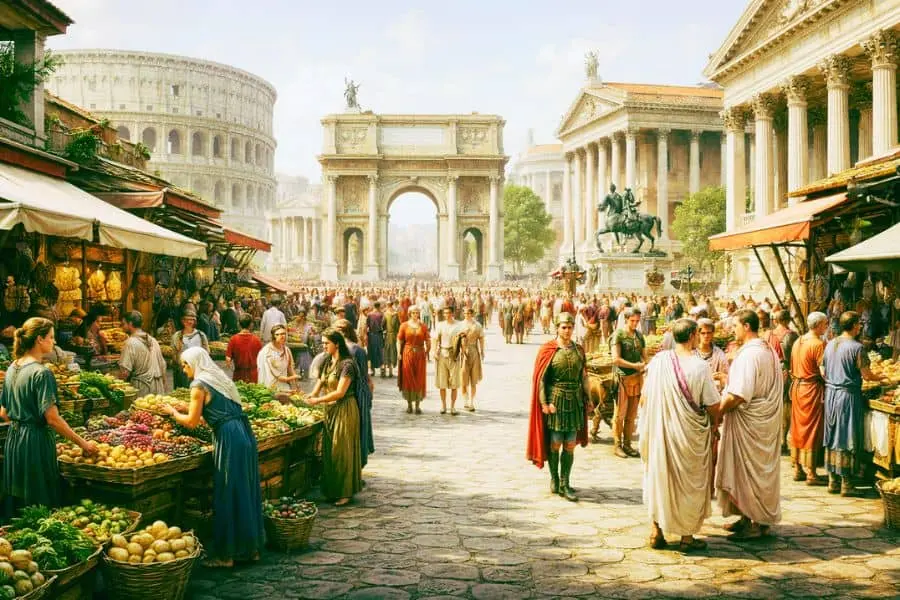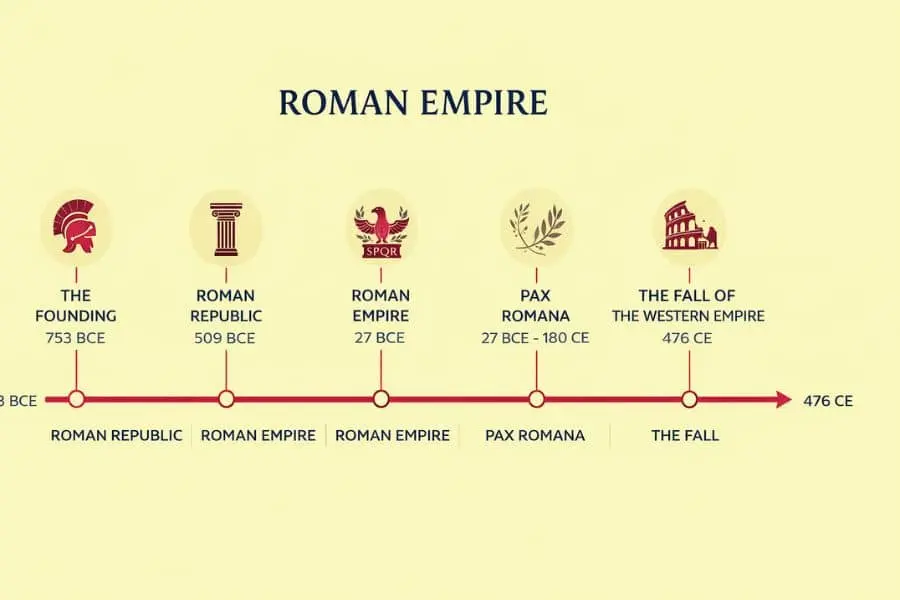
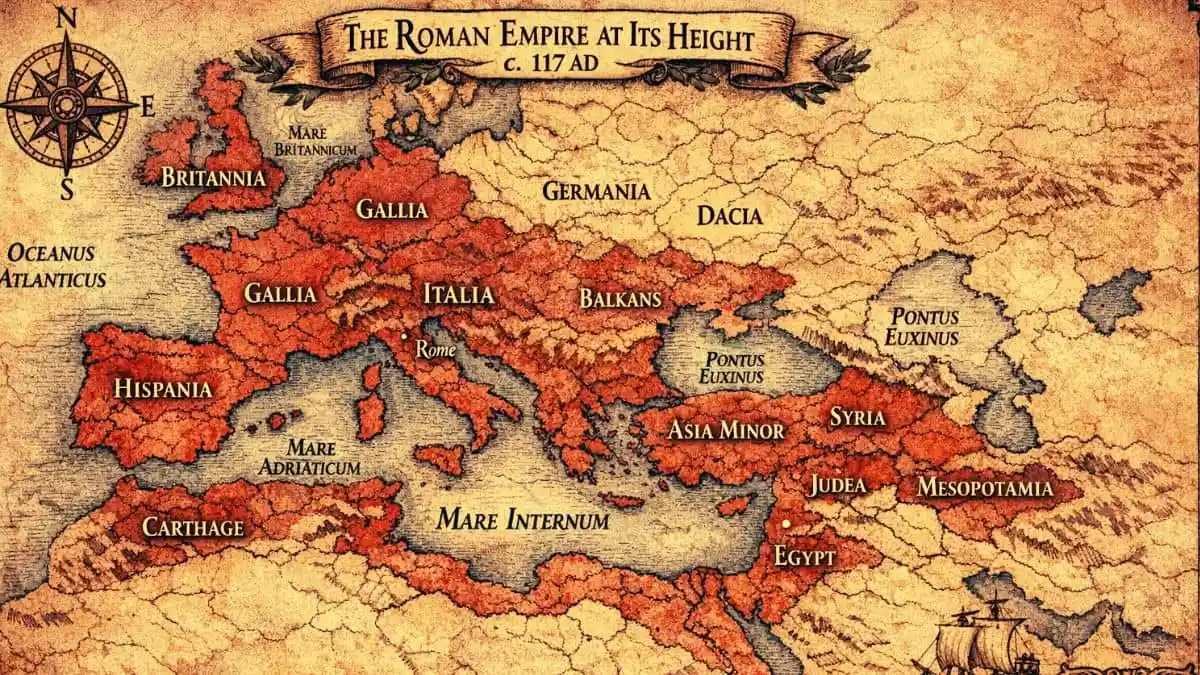
The Roman Empire is one of the greatest and most powerful cultural cities in human history. Rome, which began in 753 BC as a small settlement on the Tiber River, grew over time into a powerful republic and later developed into an empire that controlled much of Europe, North Africa, and Western Asia. At its peak, Rome controlled the entire Mediterranean Sea, which it referred to as Mare Nostrum (‘Our Sea’), and laid the foundation for modern law, government, engineering, military strategy, and culture.

Geographically vast and nationally and culturally diverse, this empire was a center of trade, innovation, and political power. Roman roads, aqueducts, architectural methods, legal systems, and administrative systems influenced not only the development of the Roman Empire but also the development of many modern countries.

It encompasses both remarkable growth and ultimate decline in the history of Rome, which spans over a thousand years. The rise, expansion, and fall of this great empire provide important lessons about the long-term consequences of factors such as state-building, effective leadership, social organization, political corruption, economic instability, and external pressures.

Studying the Roman Empire is essential to understanding the origins of modern Western culture and its influence on the world today. From here, you can easily find all the knowledge you need on this topic.

Origins of Rome

The vast Roman Empire later developed through the city of Rome. There are several legends and archaeological evidence based on historical records regarding its beginnings. This section provides a detailed account of the birth of Rome and its early system of governance. Many people have heard of the Roman Empire, but few know its origins. This is the explanation for that.

The Founding Myth

The story of Romulus and Remus

The most famous story about the origin of Rome is the legend of the two brothers, Romulus and Remus. They are considered to be the sons of the god Mars.

‘Amulius’, the king who ruled the city of ‘Alba Longa’ at that time, intended to kill the two infants, ‘Romulus’ and ‘Remus’. This thought arose because he feared that they would pose a threat to his power in the future.

However, the king ordered his servants to throw the two of them into the Tiber River. According to legend, a ‘She-wolf’ that came from a deep cave saved their lives. Later, they were found and raised from childhood by a shepherd named ‘Faustulus’.

‘Romulus’ and ‘Remus’, who were gradually growing up, had the idea of building a new city. Romulus’s idea was the location of ‘Palatine Hill’. Remus, who had an opposing idea, preferred the location of ‘Aventine Hill’. This conflict escalated to death. In the end, according to legends, ‘Romulus’ killed ‘Remus’, named the new city Rome, and became its first king.

Roman Kingdom

Role of Early

The early period of the Roman State is referred to as the ‘Roman Kingdom.’ It spans the years 753-509 B.C. During this period, history records that it was ruled by seven kings. Some of the services they performed can be described as follows.
• Urban development, road construction, and strengthening commerce
• Religious practices, laws, social customs, and construction
• Strengthening military organization and security
• Organization of areas such as ‘Palatine Hill’ and ‘Capitoline Hill.’

Social Structure (Patricians and Plebeians)

During the Roman Kingdom period, society was divided into two classes.

Ancient Roman social classes showing Patricians as elite families and Plebeians as common workers in an educational illustration

Patricians- They were elite families with power, wealth, and administrative influence, and they had special privileges with the kings and state administration.

Plebeians- They are ordinary people. They are a class involved in agriculture, trade, management activities, and local services. They did not have significant political power.

Transition from Monarchy to Republic

Due to the tyranny and unjust rule of “Tarquinius Superbus”, who acted as the last king of Rome, the people opposed his reign. Eventually, in 509 BCE, the Roman people, along with the nobles, came together to abolish the monarchy and establish a new system of governance. This came to be known as the Roman Republic. It can be considered a turning point that changed Roman history.

Rise of Rome Republic

The transition from the Roman Kingdom to the Republic was a significant moment in its history. This period marked the time that led Rome to become a powerful empire. It had a long-lasting impact due to the distribution of power to the people and representatives, the strengthening of legal governance, and the establishment of armies for foreign wars.

Political Structure

The Roman Republic’s governance was divided into three parts. All three functioned as a system of ‘Checks and balances’, regulating each other’s authority. They were as follows.

Senate
• This acted as a highly powerful and authoritative institution within the Roman Republic’s system of governance.
• It was a central body that provided state policies, economic guidance, military experiences, and legal instructions.
• Senators were often composed of individuals from wealthy and influential families.
• The rules they established served as a basic roadmap for building a long-term, stable governance structure in the Roman Republic.
Consuls
• Consuls were the two highest officials elected annually in the Roman Republic.
• They had major responsibilities such as leading the army, enforcing laws, and maintaining government administration.
• One consul had the power to veto the decision of the other consul.
• The purpose of this system was to prevent any single individual from gaining excessive and unchecked power.
Assemblies
Assemblies are the main representative bodies of the general public, especially the plebeians.
• They carried out a range of democratic functions, including making laws, deciding on state matters, and electing high officials such as Consuls.
• This system was an important step that gave the people the power to participate directly in the decision-making processes of the Roman state.

Illustration showing the Roman Republic’s Senate, Consuls, and Assemblies with senators seated, consuls standing, and citizens participating

Military Innovations

The reason the Roman Republic became largely powerful was not centralized rule, but its exceptional military system.

Legion System

Roman legion soldiers standing in organized formation with shields and centurion

• The Roman army, to organize its military strength, was divided into large units known as ‘legions’.
• A legion usually consisted of 4,000–6,000 armed soldiers, who were further divided into smaller units called maniples or cohorts.

• This arrangement provided the army with significant advantages, allowing for rapid movement, counterattacks, and greater efficiency on the battlefield.

This system has provided a considerable advantage over many hostile states.

Training and Discipline

The Roman army was built on very difficult, sudden, and continuous training methods.

Roman soldiers training with strict discipline in ancient military practice
  • The training methods of the Roman army were rigorous, continuous, and based on frequent drills, challenging every soldier’s physical and mental abilities.
  • During daily exercises, they honed essential skills such as combat, weapon use, and disciplined movement.
  • The Roman disciplinary system was based on strict rules and severe punishments, which made the management of the army and wartime operations extremely demanding.

As a result, the Roman army became one of the foremost in history.

Superior Weapons and Strategy

The production of weapons in Rome gave them a great advantage.

Gladius- The short sword used by Roman legionaries. It allowed Roman soldiers to strike their targets with great efficiency and accuracy in close combat.
Pilum- A specialized spear, the pike, was a powerful weapon used to break armor and cause damage from a distance.
Testudo- The ‘Testudo’ defensive battle technique is a specific formation used by Roman soldiers, where they align their shields together to form a tortoise-like shell, providing complete protection against spears and missile attacks.

Roman gladius, pilum, and testudo formation illustrated

These innovations and advanced technology brought Rome several uninterrupted victories.

Expansion Within Italy

At the beginning of the Roman Republic, it was able to face financial, political, and military challenges against other powers that had risen on the Italian peninsula. Rome initially reached Judea, considering these ethnic groups as the main threats there:

Latin Wars – For power with the Latin tribes

Etruscan Conflicts – Power struggle in northern Italy

Samnite Wars – Long and intense battle series

The battle confirmed the Roman dominance in the military field.

Italian Peninsula Unified

By the 3rd century BC, Rome had gained complete control over the Italian Peninsula.

  • Annexation of city-states
  • Incorporation as allied countries
  • Decentralization and administrative organization

This unification is considered a fundamental step that established Rome as an international power.

Major Wars and Expansion

It is no secret that the Roman Empire became the most powerful civilization. The main reason for this was their huge series of wars, continuous victories, and constant territorial expansion. Based on organized military power, laws, political systems, and intellectual tools, Rome maintained long-term control around the Mediterranean and extended its influence across Europe, Asia, and Africa through these military victories.

The Punic Wars (264–146 BCE)

The Punic Wars were a series of major conflicts that lasted about 100 years between Rome and the commercially powerful city-state of Carthage in North Africa. The reasons for this were commercial control, naval power, and control of Mediterranean trade routes. These military engagements can be outlined as follows.

The First Punic War (264–241 BCE)

The First Punic War (264–241 BCE) began due to a conflict over the control of Sicily. During this war, Rome strengthened its naval power and defeated Carthage, and Sicily became Rome’s first province.

Second Punic War (218–201 BCE)

The Second Punic War (218–201 BCE) was a major conflict initiated by the Carthaginian military commander Hannibal, who invaded Italy with a large number of elephants through the Alps. Although Hannibal inflicted severe damage on Rome, in the end, Rome emerged victorious, and Carthage was defeated.

The Third Punic War (149–146 BCE)

During the Third Punic War, Rome destroyed the city of Carthage. Many of the people in Carthage were killed, the city was burned, and even the ashes dried up. Along with this, all the land in Carthage came under Roman control.

Gaining Mediterranean dominance   

The Punic Wars came to an end. Rome took control of regions such as Cyprus, Sardinia, Spain, and North Africa. Through this, they were able to take full control and secure dominance over the Mediterranean Sea. By controlling these regions, Rome increased its naval and commercial power. As a result, they were able to maintain military and commercial navigation in the Mediterranean under their control. Benefiting from this, Rome described the Mediterranean Sea as “Mare Nostrum” – our sea, establishing itself as the most powerful authority in the region.

Expansion into Europe, Africa, and Asia

After the Punic Wars ended, Rome maintained its power for over a hundred years based on military and political strength, extending its control over various regions and achieving great victories. Areas such as Greece, Gaul, Egypt, and the small islands of Asia came under their rule. During this period, Rome became the most powerful authority in territorial expansion in multiple directions.

Conquest of Greece

In the 2nd century BC, Rome intervened in the conflicts of the Greek states. Later, they gained victory there.
Greek culture, philosophy, science, and architecture were able to have a strong influence on Rome.

Later, it became famous worldwide as Greco-Roman culture.

Expansion into Gaul – Julius Caesar

Julius Caesar invaded Gaul in Western Europe between 58 and 50 BC.

This is a very significant victory for Rome. It is the acquisition of the largest territory in Europe.

Caesar’s popularity and power increased, and he then exerted significant influence over the Roman Republic.

Egypt under Roman control

In 30 B.C., after Cleopatra and Mark Antony were defeated in battle, Egypt came under Roman rule.

The fertile lands along the Nile provided great agricultural products, which were a major strength for the economy of Rome.

Roman provinces and administration

Rome controlled vast areas through a system of provinces called provinces.

These provincial governors controlled

Implemented an efficient administrative system with law, taxation, and military control.

The culture of Rome spread through road networks, aqueducts, and urban planning.

The reason Rome became one of the largest empires geographically was this global expanse.

Transition from Republic to Empire

The Roman Republic existed for a long time as a strong democratic state. However, over time, internal political instability, social inequality, and the rise of ambitious generals seeking power gradually led to its downfall. From the end of the 2nd century BCE, these conflicts intensified, resulting in the failure of the Republic. Ultimately, it transitioned to a new imperial system of governance established as the Roman Empire. This transformation completely changed the history of Rome and became a significant political shift in world history. This explores that context.

Internal Conflicts

Social Wars

Between 91–88 B.C., a severe internal conflict known as the ‘Social Wars’ erupted within the Roman Republic. The primary cause was the demand for equal rights by the Italian tribes who, despite providing long-term support to Rome, were not granted citizenship. Rome initially rejected these demands, which led to heated disputes and internal wars. This eventually escalated into a full-scale series of wars referred to as the ‘Social Wars.’ In the end, Rome hoped to grant citizenship to people in many regions. However, this conflict caused significant political instability and internal crises within the Republic. It also laid the groundwork for the rise of powerful military leaders.

Ancient-style illustration of the Roman Social Wars between Roman soldiers and Italian rebels

Rise of powerful generals

During this period, the power of the Roman military grew significantly. As a result, generals who commanded the army appeared to be more powerful than the state itself. Leaders such as Marius, Sulla, Pompey, and Julius Caesar increased their personal power by gaining the loyalty of soldiers and achieving continuous victories. Due to the rise of these military leaders, state power moved away from the control of the Senate and into the hands of individual military rulers. Consequently, the republican form of government was severely undermined. This led to a massive transformation in Rome, turning its political system into a landscape of division, instability, and dominance of individual authority.

Civil Wars

The intense civil wars between soldiers and political factions vying for power severely shattered Rome. Through these conflicts, the population, military, economy, and governmental system were nearly destroyed. Power struggles like Marius–Sulla, Pompey–Caesar, and Octavian–Mark Antony created a continuous series of internal wars within the Roman Republic. By the end of these conflicts, the groundwork was laid for the formation of a new imperial system known as the Roman Empire.

Julius Caesar

Rise to Power

Julius Caesar was a skilled military general and political leader who rose to prominence in the Roman Republic. By conquering the region of Gaul (Gallic Wars), he gained immense popularity and powerful military strength. This created fear in the powerful Senate and Pompey. After a power struggle with Pompey, he captured Rome in 49 BCE. Following this victory, he was appointed ‘Dictator for Life,’ becoming a powerful figure who initiated the collapse of the Roman Republic.

Illustrated map showing Roman expansion into Gaul during Caesar’s campaigns

Reforms

After winning the civil war, Caesar introduced a large series of reforms in Rome. He organized a long tax system, systematized financial and civil systems. brought social and economic reforms such as land distribution to the poor, reducing debt burdens, and simplifying the administrative system. He also introduced the ‘Julian Calendar’, a predecessor to the new ‘Gregorian Calendar’ system. All of these programs were very popular among the people. The rapid growth of his power and popularity caused the Senate to fear him, which led to an increase in opposition against him.

Assassination – 44 BCE

Because Julius Caesar’s concentration of power caused fear and discomfort among the members of the Senate, on March 15, 44 BCE (“Ides of March”), a group of political opponents, including ‘Brutus’ and ‘Cassius’, assassinated him during a Senate session. This act, justified under the pretext of “saving the country,” led to additional civil strife and intense power struggles throughout Rome. It is considered a major and unique event that served as a pivotal step toward the fall of the Roman Republic and the rise of the Roman Empire.

Octavian / Augustus Caesar

First Roman Emperor

Octavian, the heir of Julius Caesar, won the final civil war, and in 27 BCE, the Senate gave him the honorary title ‘Augustus,’ making him the first emperor of Rome. Although his power was a personal leadership position, he established a balanced system of governance between law, Senate administration, and military control, stabilizing the Roman governmental system. This ended the power struggles that arose after the assassination of Julius Caesar, concluding the Roman Republic era and marking the beginning of the Roman Empire.

Marble-style illustration of Augustus Caesar in classical Roman sculpture design

Reorganization of Government

Augustus completely reorganized the Roman state administration. He transformed the Roman army into a professional army. A system was established to maintain 28 permanent military units. He strengthened the provincial administration and organized new governmental ministries and legal affairs. Tax system reforms and urban development programs were implemented. Through these reforms, Rome became a strong, stable, and extensive empire legally, politically, and economically.

Golden Age of the Roman Empire

The ‘Golden Age’ of the Roman Empire refers to the long period known as the ‘Pax Romana’. During this time, the Roman Empire became a powerful, wealthy, and culturally advanced state.

Pax Romana

Pax Romana refers to the ‘Roman Peace,’ a period of relative global peace that lasted for about 200 years throughout the empire. The Pax Romana era is considered a unique and fully developed period in the history of the Roman Empire, and it is also referred to as the second-longest period of stability in human history under the Roman Empire.

Economic Prosperity

During the Pax Romana period, the Roman Empire experienced significant economic growth. Stable governance and secure trade routes led to increased agricultural production. Industry and workshops improved. Urban development accelerated. All this progress resulted in substantial revenue for Rome through resources, taxes, and trade routes. This strengthened the system of resource distribution within the empire. During the Pax Romana, advancements in agriculture, the safety of trade routes, urban development, and improvements in workshops and commerce made Rome a very wealthy and prosperous empire.

Peace and Stability

Many regions within the Roman Empire were securely controlled. Due to the reduction of internal conflicts, the strengthening of central authority, and the effective functioning of the legal and judicial system, law and regulatory order were established throughout the empire. The road network and military strength provided safe travel and the necessary space for commercial and agricultural activities. People were able to carry out business, farming, trade, and infrastructure development freely.

Cultural Achievements

Architecture (Colosseum, Aqueducts, Roads)

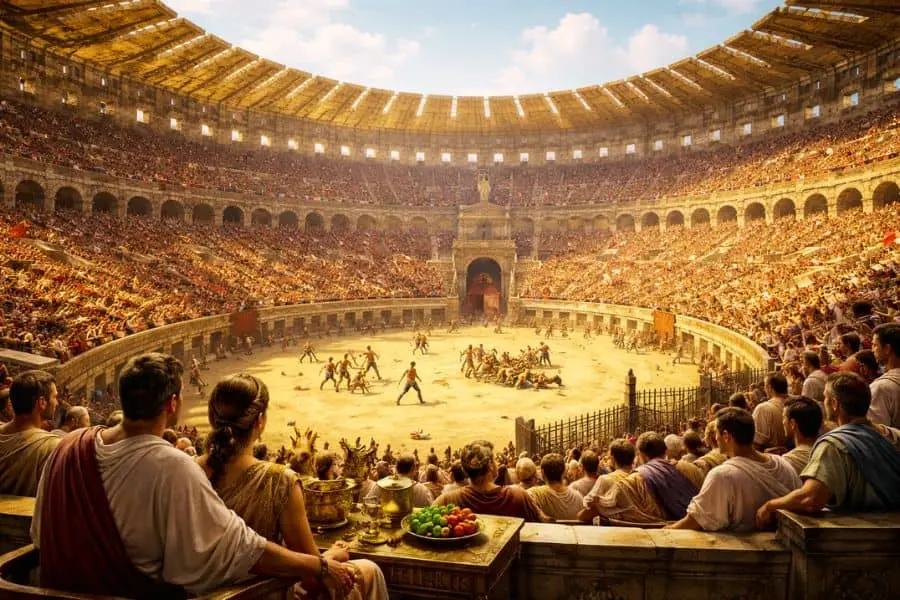
During the ‘Pax Romana’ era, the art of building in Rome reached its highest level. The ‘Colosseum’ was a large arena and stage for games and performances, entertaining the population as the world’s most famous ‘amphitheater’. It was used for gladiator contests, public spectacles, and festivals. Aqueducts, the water supply systems, were built as top-level engineering creations to transport clean water over long distances to villages and cities. Roads – famous for the saying “All roads lead to Rome” – were extremely important for facilitating the movement of citizens, trade activities, message exchanges, and administrative operations. All these buildings and networks of roads, water systems, and entertainment centers provided high development for the Roman people during the ‘Pax Romana’ era.

Ancient Roman Colosseum, aqueducts, and stone roads in Pax Romana era

Roman Law

The Roman legal system was a fundamental foundation for many legal traditions in the modern world. Laws such as the ‘Twelve Tables’, ‘Natural Law’, and ‘Citizenship laws’ were used to govern Roman social life and ensure legal justice and equality. These laws popularized principles such as rights, jurisprudence, and legal equality. The Roman legal system still serves as the basis for most modern state laws today. It is regarded as a unique system for the functioning of society under the law.

Language (Latin) and Literature

Latin was the language formally used throughout the Roman Empire. Later, it became the foundational language for many languages around the world. Due to the widespread use of Latin throughout Rome, languages known today as the modern Romance languages, such as Spanish, French, Italian, Portuguese, and Romanian, originated from it. The literature, poetry, speeches, and historical works of writers like Virgil, Ovid, and Cicero demonstrated the completeness and strength of the Latin language, and their works continue to make an enduring contribution today. This language and its literature form a fundamental aspect of Roman culture and have exerted a significant influence on world history.

Trade and Economy

Mediterranean Trade Network

Rome became the world’s largest commercial network by controlling the Mediterranean Sea. Through this network, goods such as Asian textiles, African incense, and European metals traveled via Roman ports. Because Rome was the main commercial power in the Mediterranean, extensive trade routes connected Europe, Asia, and Africa. This facilitated the widespread exchange of textiles, minerals, spices, agricultural products, grains, luxury goods, and resources.

Map showing Roman Mediterranean trade routes connecting Europe, Asia, and Africa

Currency System

Rome used stable currency units like the ‘Denarius’ to facilitate trade, standardize prices, and strengthen the economy by supporting state taxes and wage systems. Having a uniform currency system across the empire made commercial exchanges very easy, and the empire’s economy grew proportionally alongside commercial activities and state administration.

Agriculture and Urban Centers

The fundamental basis of the Roman Empire’s economy was agriculture. The increase in products like grain, olive oil, and wine contributed to economic strength. ‘Grapes’, ‘olives’, the ‘textile’ industry, and workshops also helped in economic growth. Cities such as ‘Rome’, ‘Alexandria’, ‘Carthage’, and ‘Antioch’ became commercial, cultural, and political centers. Trade, industry, and state institutions worked together, developing as a modern urban resource.

Decline of the Empire

The Roman Empire maintained extensive power throughout Europe and the Mediterranean region. Gradually, a series of political, economic, communication, and social challenges began to weaken it. These interconnected challenges caused the empire’s power to gradually diminish. In the 2nd century CE, the Roman Empire reached its peak of expansion, but after the 3rd century, economic and social crises, political instability, and military weakness emerged. As a result, this led to the complete collapse of the Western Roman Empire in 476 CE.

Political Decline

Weak and corrupt emperors

In the final centuries of the Roman Empire, many emperors ruled with incompetence, corruption, and political ineptitude. Their power-grabbing actions, conspiracies, and military campaigns led to upheaval and instability in Rome. During the last six centuries, Rome lacked stable leadership, and the repeated deaths or overthrows of emperors severely affected the nation’s governance and security. This led to a loss of public trust, reduced security, and resulted in an unstable system of governance.

Division of the empire (East & West)

In 285 AD, Emperor Diocletian found it difficult to govern the vast Roman Empire. As a result, he divided it into two parts: Western Rome and Eastern Rome (the Byzantine Empire). The eastern part had a strong economy and abundant resources, and maintained a stable administrative system for a long time. In contrast, the western part declined rapidly due to a weak economy, continuous invasions, and political instability. This division shattered the unified power of the Roman Empire. The lack of complete military, financial, and administrative strength in the center caused significant harm to the Western Empire.

Realistic digital painting of future Olympic Games with modern tech and global athletes

Economic Problems

Heavy taxation

The state needed money to cover war expenses and maintain a large army. With the decline of state trade, the ordinary people had to bear a heavy tax burden. As a result, farmers, businessmen, small industrialists, and urban residents were severely affected in their economic lives. Those who could not bear the weight of the taxes fell into economic decline. Moreover, this situation caused disruptions in the imperial economic system, impacting social balance and stability.

Inflation

Ancient Roman coins on a stone table in a clean macro-style illustration

Rome frequently minted new coins due to the urgent need for money for wars. The value of the coins decreased because the metal content of the new coins was low, causing the currency to lose its worth.

This monetary inflation led to higher prices for food, clothing, services, and commercial activities. With the government losing control over wealth, the economy became unstable, and the centralised control of the empire’s resources collapsed severely.

Slave economy collapse

The Roman economy, for a long time, was built on a large portion of slave labor. These workers were engaged in industry, farming, construction, and business activities. However, military defeats, a shortage of new slaves, and the breakdown of the slave system led to a decrease in the supply of slaves. This severely affected agricultural, manufacturing, and commercial activities, causing the Roman economy to weaken significantly and collapse.

Military Weakness

Invasions by Germanic tribes

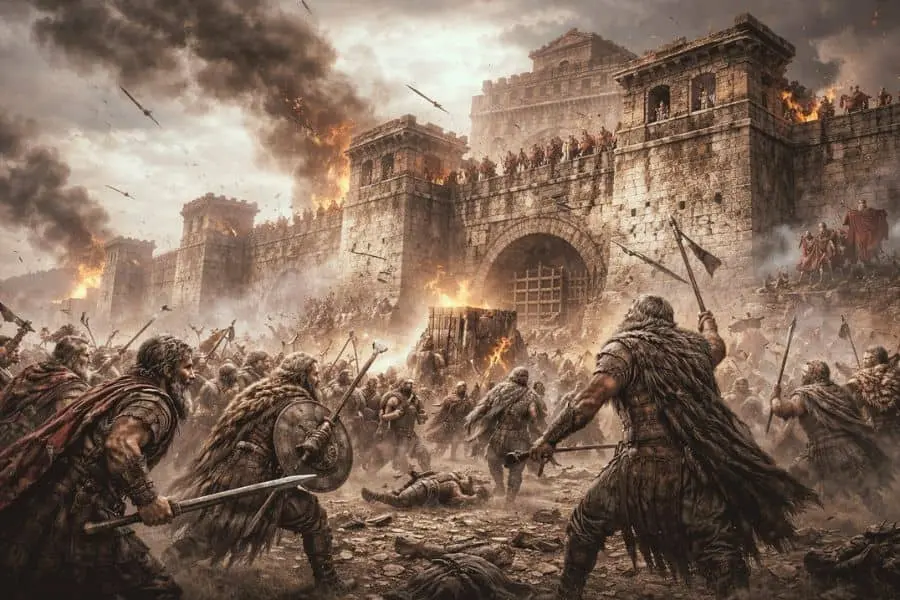
The main reason for the fall of the Western Roman Empire was the constant attacks on its borders by Germanic tribes such as the Visigoths, Vandals, and Ostrogoths. In 410 AD, the Visigoths sacked the city of Rome, and in 455 AD, the Vandals carried out another devastating attack. Their sudden capture of the city, burning of Rome, and military actions overwhelmed the weakened Roman forces. These events were significant turning points in the instability and eventual collapse of the Western Empire.

Dependence on mercenaries

The Roman army was initially a strong, united, and patriotic force that provided great security to Rome. However, in its later years, Rome increasingly relied on foreign mercenaries (external warriors). Their disloyalty, indifference towards Rome, and the ability to empower opposing groups made it increasingly vulnerable. This situation posed a serious and long-term threat to Rome’s security.

Social Decay

Loss of civic responsibility

The commitment of Roman citizens to civil duties, public service, unity, and projects gradually declined. Along with this, corruption, weak economic conditions, disregard for the law, cultural decay, fraud, and the loss of honest responsibility for public service destabilised society. The lack of citizens’ dedication to the state, law, the military, and communal work, along with the collapse of trust in authority, damaged the country’s social and economic reputation.

Population decline

Due to war, disease, food shortages, weak economic conditions, and low birth rates, the population of Rome declined sharply. The population decline, combined with a shortage of workers, led to a collapse in agricultural production and a reduction in army numbers. The decline in trade, industry, and agriculture was a major factor in the breakdown of the strong social, economic, and military systems of the Roman Empire. All these factors together drew Rome into an obscure state from its former greatness.

The Fall of the Western Roman Empire (476 CE)

The final fall of the Western Roman Empire in 476 AD is considered a significant moment in world history. This fall was not a single event, but a long, complex process involving several years of decline, economic problems, political instability, and foreign invasions. All of these factors combined led to the ultimate collapse of the empire.

A realistic illustration showing the fall of the Western Roman Empire in 476 CE

Problems of barbarian invaders (Visigoths, Vandals, Ostrogoths)

During the 4th and 5th centuries, due to pandemics, climatic changes, and the invasions of the ‘Huns’ in Europe, many Germanic peoples, especially the ‘Visigoths’, ‘Vandals’, and ‘Ostrogoths’, migrated to the Western Roman Empire. The ‘Visigoths’ fled from the ‘Hun’ invasions and settled within the Roman territories. There, they fought with Rome over food and land issues. The Vandals traveled through Gaul and Spain and took control of North Africa, creating a power crisis along the Mediterranean coast. The ‘Ostrogoths’, freed from ‘Hun’ control, entered Italy and established their rule. These mobile groups severely weakened the defense of the Roman Empire, destabilized provincial administration, and weakened the economy.

Sack of Rome – 410 CE & 455 CE

Throughout history, the city of Rome was famous as a city that was never helpless and could overcome challenges, yet it too was subjected to various attacks during times when the empire was weak.

Visigoths (410 CE)

In 410 AD, under the leadership of the Visigoth leader ‘Alaric’, the Visigoth army attacked the city of Rome, carrying out looting, destructive acts, and oppressive actions. This was the first time in 800 years that Rome had been defeated by an internal power. It is considered an event that highlighted the vulnerability of the Roman Empire and caused fear and mistrust among the people. This attack sent a powerful and shocking message to the ancient world and to the Roman populace.

Vandals (455 CE )

In 455 CE, the Vandal army under the leadership of Genseric once again brought severe destruction to Rome. They plundered the city’s wealth, goods, royal treasures, arsenals, and financial reserves completely. This led to the term ‘Vandalism.’ This second destruction caused the prestige, power, and security of the Roman Empire to diminish entirely and was considered a heavier and more severe blow than the event of 410 CE. It was one of the factors that ultimately led to the fall of the Western Empire.

The fall of the last emperor, Romulus Augustulus (476 CE)

In 476 AD, when the Germanic leader Odoacer, who had limited power, deposed ‘Romulus Augustulus’, the last Roman emperor, the final phase of the Western Roman Empire was confirmed. Since ‘Romulus Augustulus’ was a young and powerless emperor, ‘Odoacer’ took over authority as the governor of Italy. As ‘Odoacer’ was no longer a Roman emperor, the ancient Roman administrative system officially came to an end. This event officially marked the end of the Western Roman Empire. Historians regard it as the end of classical antiquity and the beginning of the Middle Ages.

Legacy of the Roman Empire

As a powerful state that controlled a vast geographical area, the Roman Empire left behind a strong legacy directly connected to world culture, law, governance, language, architecture, religion, and the dynamics of Western civilization. Although the Roman Empire collapsed, its influence continues uninterrupted today through law, governance, language, architecture, and religion, making it an essential element in human history. This legacy has had enormous and long-lasting impacts as the foundation of Western civilization and as a significant part of world culture.

Ancient Rome legacy illustration with soldier and iconic monuments

Influences based on law, government control, language, and architecture

Roman Law is a body of legal literature that is a predecessor to modern legal systems around the world. Legal documents such as the ‘Twelve Tables’ and the ‘Justinian Code’ provided a legal foundation for many countries. Many legal concepts used today, such as ‘contracts,’ ‘property rights,’ and ‘equality of all persons before the law,’ originated from Roman Law. It made a fundamental contribution to the Civil Law system and influenced Roman principles concerning citizens’ rights, the writing of laws, government structures, and language. Furthermore, Roman Law continues to be used as a fundamental support in the legal systems of many countries.

The administrative structure of the Roman Empire served as a fundamental model for many democratic countries in the world today. Roman political concepts such as the ‘Senate’, ‘Republic ’, and ‘Checks and Balances’, along with organizational practices like the bicameral parliament, consuls, and legal sessions, provided the foundation for establishing a systematic government. Through these models, principles of democracy, representation of the people, and legal frameworks spread to the governance systems of the Western world, securing Rome’s place in history as a great political power.

Latin functioned as the principal language used across the Roman Empire. Even today, it is not a dead language and is considered the mother tongue of many European languages. It served as the foundation for the development of languages such as French, Italian, Spanish, Portuguese, and Romanian, which are referred to as Romance Languages. Furthermore, more than 60% of English vocabulary is derived from Latin. Latin terms are still used in scientific, legal, medical, and religious fields.

Roman architecture is the foundation of modern construction. It includes building styles such as arches, domes, aqueducts, and amphitheaters. Roman architecture has had a strong influence on modern buildings, bridges, structures, stadiums, and city planning around the world. Roman innovations like arches, vaulted housing designs, aqueducts, and amphitheaters like the Colosseum are still used in modern urban planning, bridges, and governmental buildings such as parliaments and courthouses. It represents a revolutionary contribution to the field of architectural art in world history.

Rise of the Byzantine Empire – Eastern Rome

Although the Western Roman Empire fell in 476 AD, the Eastern Roman Empire (Byzantine Empire) remained a powerful state for more than another 1,000 years.

The city of Constantinople (now Istanbul) served as the center, where the Byzantine Empire revived Roman law, architecture, military style, and Greco-Roman culture.

The Justinian Code legal tradition, while having a strong influence on the development of modern law, preserved Roman heritage and served as a fundamental guide for the Western world.

The Byzantine Empire preserved the Roman heritage for another generation, making a significant contribution to history and culture.

The Byzantine Empire was a complex palace where Roman law, Roman culture, the Latin language, and Greek culture blended, and it became a forerunner of Mediterranean civilization.

Later, the Byzantine Empire connected with Muslim and African civilizations, having a significant impact on the real world.

Impact on Christianity

The main reason for the spread of Christianity in the Roman Empire was Emperor Constantine’s granting freedom to the Christian religion through the Edict of Milan in 313 AD. Subsequently, in 380 AD, it was recognized as the state religion of the Roman Empire, and Christianity was disseminated among tribes, cities, nations, and continents.

Christian teachings spread rapidly throughout the empire through the Roman road network, organized administrative systems, and existing educational systems. Later, Christianity became the fundamental and powerful cultural religion in Europe, and today it has become the largest religion in the world.

Lasting influence on Western civilization

The Roman Empire laid the foundation for Western Europe’s civilization, law, politics, language, architecture, and culture. Modern legal systems, parliamentary systems, university systems, arts, theater, literature, urban planning, and many contemporary forms of governance in the Western world are all directly or indirectly based on the principles of the Roman Empire.

Among the principles initiated by Rome are legal systems, republican governance, engineering and mathematics, language (Latin), the spread of Christian doctrine, traditions, arts, literature, and the Renaissance. As a result, even thousands of years later, the Roman Empire remains a fundamental pillar and legacy in the Western world, and Roman concepts, law, culture, technology, and administration continue to influence the social life of many Western countries today.

Conclusion

The Roman Empire began as a small town but grew into a powerful state through a strong military, industrial development, and political organization. It dominated Europe, North Africa, and the Middle East and was pioneering in law, engineering, roads, and cultural traditions.

However, corruption, economic crises, unstable politics, and external invasions led to the fall of the Western Empire in 476 AD. Rome’s legacy continues to influence modern governance, law, architecture, and cultural development. It provides essential lessons for world history, demonstrating the importance of maintaining stability in statecraft, legal systems, economic management, and social unity.

The Roman experience continues to serve as a practical guide for social organization, leadership, and international relations. Ultimately, we hope these points will help you make clearer and more reliable decisions.

FAQs

How did the Roman Empire rise to power?

Rome rose through military strength, strategic alliances, and political reforms that unified the Italian peninsula and expanded outward.

What made the Roman Empire expand so rapidly?

A powerful army, advanced infrastructure, and efficient administration helped Rome conquer territories across Europe, Africa, and Asia.

Why did the Roman Empire fall?

The empire collapsed due to internal corruption, economic decline, political instability, and invasions by barbarian tribes.

Author

Lulu Freeman, a Stanford University History graduate, specializes in researching wars, cultures, and ancient civilizations. With years of experience in historical research and cultural studies, she shares insightful articles that explore humanity’s heritage and evolution. Her passion for uncovering the past inspires readers to understand the roots shaping our modern world

Write A Comment