
From 1914 to 1918, it reshaped global politics and brought about social transformation. It caused permanent divisions among the nations involved. The war occurred on an unprecedented scale. More than 30 countries were involved in it. Over 65 million soldiers were mobilized. Approximately 20 million people died from both military and civilian sectors.
Unlike previous wars that were confined to regional boundaries, the First World War was truly a global conflict. It was fought not only in Europe but also in Africa, the Middle East, and Asia, and battles extended across the seas and skies. The outcome of the war changed the map of Europe. Empires were overturned. Moreover, it laid the groundwork for future international conflicts, including the Second World War.
This article explores the main causes, major powers, key events, and consequences of the First World War. It will highlight both the positive outcomes and the destructive impacts.
Table of Contents
Quick Facts
| Fact | Detail |
| Name | World War I (also called The Great War) |
| Period | July 28, 1914 − November 11, 1918 |
| Main Trigger | Assassination of Archduke Franz Ferdinand on June 28, 1914 |
| Major Causes | Militarism, Alliances, Imperialism, Nationalism (M.A.I.N.) |
| Central Powers | Germany, Austria‑Hungary, Ottoman Empire, Bulgaria |
| Allied Powers | France, Britain, Russia, Italy (from 1915), United States (from 1917) |
| Type of Warfare | Trench warfare, new military technology (machine guns, tanks, gas) |
| Estimated Casualties | Millions of soldiers & civilians affected (huge global losses) |
| Ended With | Armistice on November 11, 1918 and Treaty of Versailles (1919) |
| Major Outcome | Collapse of empires, geopolitical changes, laid groundwo |
Main Causes of World War I
Historians often explain the causes of the First World War using the acronym M.A.I.N – Militarism, Alliances, Imperialism, and Nationalism. Each of these factors contributed to the growing tensions in Europe, and the assassination of Archduke Franz Ferdinand in 1914 acted as the spark that ignited the war.

By the early part of the 20th century, European nations were engaged in intense arms races. Germany and Britain had built strong navies, while France and Russia expanded their armies. The belief that military strength was key to national security created a culture of militarism. Kings allocated enormous budgets for weapons production. New technologies such as machine guns, tanks, and chemical weapons were developed to prepare for potential conflicts.
Militarism
By the early part of the 20th century, European nations were engaged in intense arms races. Germany and Britain had built strong navies, while France and Russia expanded their armies. The belief that military strength was key to national security created a culture of militarism. Kings allocated enormous budgets for weapons production. New technologies such as machine guns, tanks, and chemical weapons were developed to prepare for potential conflicts.
Alliances
Europe was divided into two major alliances:
Triple Alliance (1882): Germany, Austria-Hungary, and Italy.
Triple Entente (1907): France, Russia, and Britain.
It was intended to maintain a balance of power through this alliance. However, in reality, it increased the risk of a large-scale war. After attacking one country, its allies were bound to get involved. This led to a chain reaction of declaring war.
Imperialism
At this time, European powers were competing for colonies in Africa, Asia, and the Middle East. This clashed with the interests of Britain and France. These imperialist rivalries increased hostility and distrust among nations. Each of them tried to protect and expand their global influence.
Nationalism
In Europe, especially in the Balkan region, nationalist movements grew strong. Under the rule of Austria-Hungary and the Ottoman Empire, ethnic groups hoped for freedom. Powerful nations like Germany and France promoted intense patriotism. Nationalism created pride but also fostered aggressive rivalry, which stirred tensions across the continent.
The Assassination of Archduke Franz Ferdinand

The most immediate cause of World War I was the assassination of Archduke Franz Ferdinand, heir to the Austro-Hungarian throne, in Sarajevo on June 28, 1914, by Gavrilo Princip, a Serbian nationalist. Austria-Hungary blamed Serbia and, with the support of Germany, declared war. This triggered a domino effect, drawing more alliances into conflict, which transformed the regional crisis into a world war.
Major Powers in World War I
The First World War was not fought by just two or three nations. It was a global war involving major powers, their colonies, and allied factions across different continents. However, the conflict was primarily divided between two opposing military alliances. These were the Central Powers and the Allied Powers.

The Central Powers
The Central Powers were led by Germany and Austria-Hungary, later joined by the Ottoman Empire and Bulgaria. Their strategic goal was to expand influence, secure territories, and weaken rival powers.
1. Germany
The most powerful member of the Central Powers. Had the strongest army in Europe, with advanced weapons and efficient military strategies. Sought to challenge Britain’s naval supremacy and expand its empire. Played a leading role in launching offensives on the Western and Eastern Fronts.
2. Austria-Hungary
A multi-ethnic empire struggling with internal nationalist movements. The assassination of Archduke Franz Ferdinand was the direct cause of the war. Fought Serbia in the Balkans and relied heavily on German military support.
3. Ottoman Empire
Entered the war in 1914, siding with Germany. Controlled strategic regions like the Dardanelles and the Middle East. Its involvement opened up new battlefronts, including Gallipoli, Mesopotamia, and Palestine.
4. Bulgaria
Joined the Central Powers in 1915. Motivated by territorial disputes with Serbia and Greece. Contributed mainly to the Balkan front.
The Allied Powers
The Allied Powers were a large and more diverse coalition composed of major powers such as Britain, France, and Russia. Later, Italy, Japan, the United States, and many smaller nations joined them.
1. France
Determined to regain Alsace-Lorraine, lost to Germany in 1871. It was a major battlefield in the war, and suffered heavy casualties. Played a major role in the Western Front, especially in battles like Verdun and the Somme.
2. Russia
Entered the war to support Serbia and maintain influence in the Balkans. Mobilized the largest army in Europe, though poorly equipped compared to Germany. Faced internal crises, leading to the Russian Revolution of 1917 and eventual withdrawal from the war.
3. Britain
Entered the war after Germany invaded Belgium in violation of its neutrality. Controlled the world’s largest navy, which played a critical role in blockading Germany. Relied heavily on colonial troops from India, Africa, Australia, and Canada.
4. Italy
Initially part of the Triple Alliance but switched sides in 1915, joining the Allies. Motivated by promises of territorial gains from Austria-Hungary.
5. United States
Joined the Allies in 1917 after repeated German submarine attacks and the infamous Zimmermann Telegram. Brought fresh manpower, resources, and financial strength. Its entry turned the tide of the war in favor of the Allies.
6. Other Allied Nations
Japan seized German colonies in Asia and the Pacific. Romania, Greece, Belgium, Serbia, and Portugal also joined the Allies.
Importance of Smaller Nations
While the major powers carried the weight of the conflict, smaller nations played significant roles. Belgium’s resistance delayed German advances, Serbia’s defense triggered the initial escalation, and colonial soldiers from Africa and Asia demonstrated the truly global scale of the war.
Beginning and End of World War I
The First World War began in 1914 and ended in 1918, lasting for more than four years. Although short compared to other conflicts, it was one of the deadliest wars in human history. The war extended through various phases, including expansion, initial battles, stalemate on the Western Front, intervention of new powers, and ultimately the collapse of the Central Powers.
The Beginning of World War I (1914)
Assassination and Declarations of War

On June 28, 1914, in the city of Sarajevo, Archduke Franz Ferdinand of Austria-Hungary was assassinated. This was the incident that led to the outbreak of the First World War.
With the support of Germany, Austria-Hungary declared war on Serbia on July 28, 1914. Serbia received military support from Russia. Germany was prompted to react by declaring war on Russia.
France joined the war against Germany. When Germany invaded Belgium, Britain entered the war on August 4, 1914. Within a few weeks, much of Europe was engulfed by the war.
The Schlieffen Plan
Germany’s strategy was to quickly defeat France by invading through Belgium, then turn east to fight Russia.
This plan brought Britain into the war because Belgium’s neutrality had been guaranteed by Britain.
The German advance was halted at the First Battle of the Marne (September 1914), marking the beginning of trench warfare.
Stalemate and Trench Warfare (1915–1916)

The Western Front, stretching from the North Sea to Switzerland, became a frozen battlefield of trenches. Soldiers lived in horrific conditions, facing mud, disease, and constant shelling.
- Battle of Verdun (1916): Lasted for about 10 months, with over 700,000 people wounded.
- Battle of the Somme (1916): Over a million people were wounded, and the first use of tanks was introduced.
- Battles on the Eastern Front were more mobile. However, due to weak equipment and leadership, Russia suffered enormous losses.
Expansion of the War
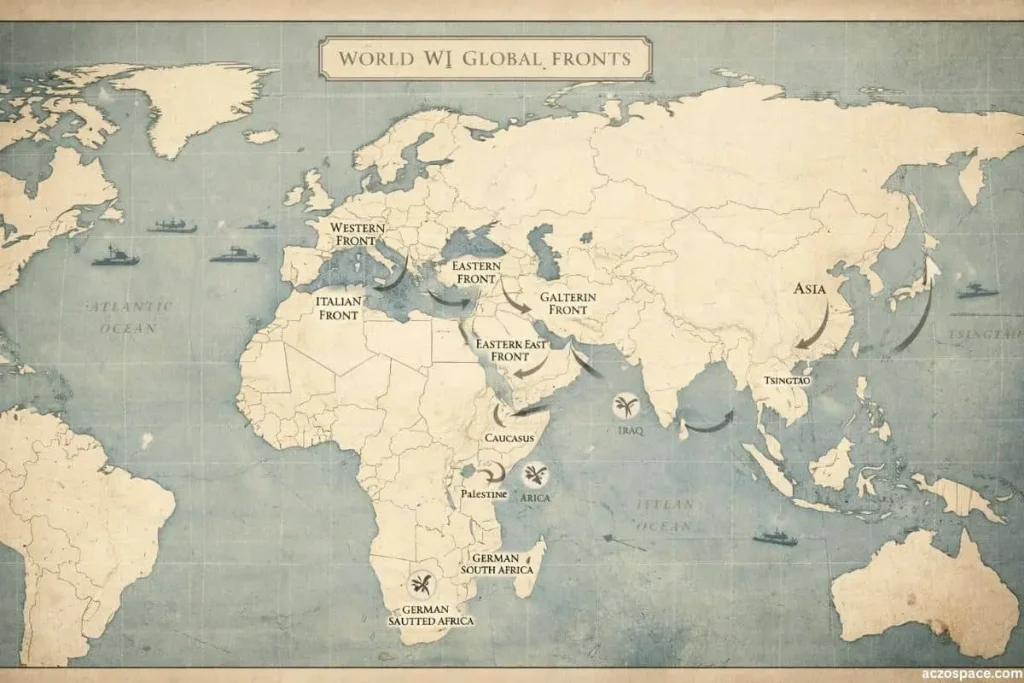
The war spread beyond Europe:
Gallipoli Campaign (1915–1916): The Allied attempt to control the Dardanelles failed. Australian and New Zealand forces (ANZAC) in particular suffered heavy losses.
Middle Eastern Front: With Arab support, British forces fought against the Ottoman Empire.
Africa and Asia: They became sites of colonial warfare, and colonial soldiers fought on behalf of their European rulers.
Turning Points (1917)
Russian Revolution
In March 1917, Tsar Nicholas II abdicated after protests and defeats in the war. In November, the Bolsheviks, led by Lenin, seized power and signed the Treaty of Brest-Litovsk (March 1918) with Germany, pulling Russia out of the war.

Entry of the United States
Germany’s unrestricted submarine warfare sank ships like the Lusitania (1915), angering Americans. The Zimmermann Telegram (1917), in which Germany encouraged Mexico to attack the U.S., pushed America into the war. The U.S. declared war on Germany on April 6, 1917, providing fresh troops and resources to the Allies.
The End of World War I (1918)
The German Spring Offensive (1918)
Before a large number of American troops arrived, Germany launched a massive offensive on the Western Front. They initially achieved some victories. However, exhaustion and supply shortages weakened the German army.
Allied Counteroffensive
From July 1918, the Allies launched a daily series of attacks. These pushed the German army back. During this power shift, American soldiers were able to play a decisive role.
Collapse of the Central Powers
Bulgaria surrendered in September 1918. The Ottoman Empire signed an armistice in October. Due to internal revolution, Austria-Hungary collapsed and surrendered in November.
German Surrender
The naval forces faced food shortages. A civil war was about to break out in Germany, along with strikes and riots. In this situation, the second Kaiser Wilhelm abdicated on November 9, 1918. Later, Germany officially marked the end of the war with the signing of an armistice on November 11, 1918.

Treaty of Versailles (1919)
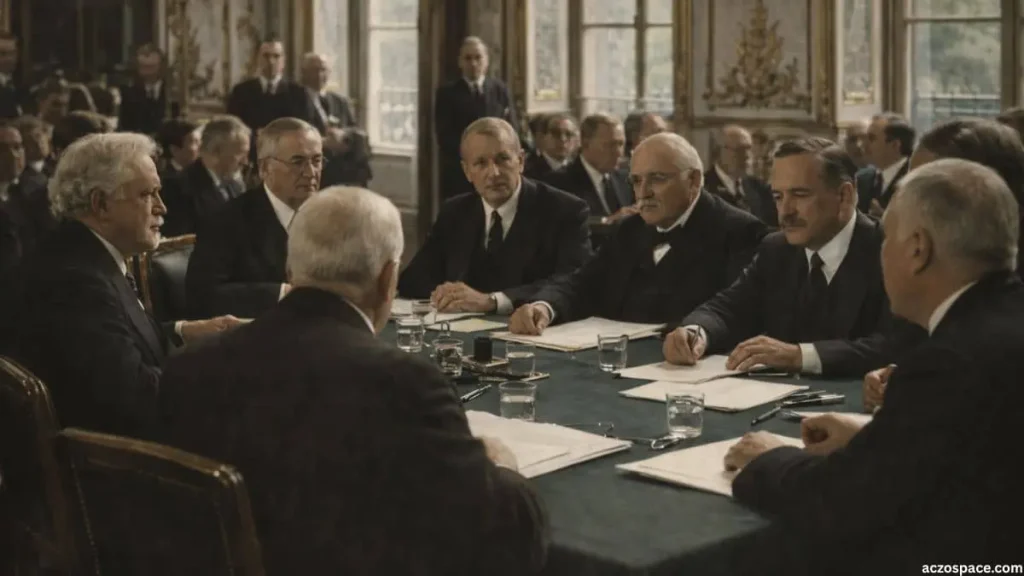
The Treaty of Versailles, signed on June 28, 1919, marked the formal end of World War I between Germany and the Allied powers, bringing an official conclusion to the devastating conflict. It was one of the most significant peace treaties in history and also one of the most controversial. The treaty aimed to secure peace, punish Germany, and prevent future wars. However, its harsh terms ultimately led to dissatisfaction and instability in Europe.
The Paris Peace Conference
After the war ended in November 1918, leaders of the Allied nations gathered in Paris in January 1919 for peace negotiations. The main decision-makers, often called the “Big Four,” were:
- Woodrow Wilson (USA)
- David Lloyd George (Britain)
- Georges Clemenceau (France)
- Vittorio Orlando (Italy)
American President Wilson hoped for a just and lasting peace based on his fourteen points. France and Britain were demanding severe punishments for Germany.
Main Provisions of the Treaty
War Guilt Clause (Article 231)
Germany was compelled to acknowledge sole responsibility for starting the war. This clause became a major source of humiliation for the German people.
Reparations
Germany had to pay enormous financial reparations to the Allies, initially set at 132 billion gold marks. These payments crippled Germany’s post-war economy, causing hyperinflation and unemployment.
Territorial Losses
Germany lost about 13% of its territory and 10% of its population. Alsace-Lorraine was returned to France. Poland gained territory, including the Polish Corridor, which gave it access to the sea. Germany’s overseas colonies were taken and given to Allied nations as mandates under the League of Nations.
Military Restrictions
The German army was limited to 100,000 soldiers. No air force, submarines, or heavy artillery were allowed. The Rhineland was demilitarized, meaning no German troops could be stationed there.
League of Nations
The treaty created the League of Nations, an international organization designed to prevent future wars and promote peace. Ironically, the U.S. Congress rejected membership, weakening the League’s effectiveness.
Reactions to the Treaty
Germany: Outraged and humiliated. Many Germans described the treaty as a “Diktat,” meaning it was an imposed agreement rather than a fair negotiation. Many saw it as unjust and a betrayal of Wilson’s promise of a fair settlement.
France: Satisfied with Germany’s punishment but wished for even stricter measures.
Britain: Divided—some felt the treaty was too harsh, others believed it was too lenient.
United States: The Senate refused to ratify the treaty, and the U.S. signed a separate peace agreement with Germany in 1921.
Legacy of the Treaty of Versailles
While the treaty ended World War I, it failed to create lasting peace. Instead, it planted the seeds of future conflict:
- Economic hardship and humiliation in Germany created fertile ground for extremist ideologies.
- The rise of Adolf Hitler and the Nazi Party in the 1930s was fueled by anger over Versailles.
- Many historians argue that the treaty directly contributed to the outbreak of World War II just two decades later.
Positive Outcomes of World War I

Although World War I was one of the deadliest and most destructive conflicts in history, it was not without certain positive outcomes. The war brought about significant changes in technology, medicine, society, and international relations. These developments shaped the modern world in profound ways.
Advances in Technology and Warfare
World War I is often called the first modern war because of the revolutionary technologies that were introduced.
Aviation: Airplanes were initially used for reconnaissance but quickly evolved into fighter planes and bombers. This laid the foundation for modern air forces.
Tanks: First used in the Battle of the Somme (1916), tanks changed ground warfare forever.
Communication: Wireless radios and telegraphs improved battlefield coordination.
Naval Warfare: Submarines (U-boats) introduced stealth attacks at sea.
Many of these innovations continued to develop after the war and played a crucial role in later conflicts and civilian life.
Medical Breakthroughs
The massive number of casualties forced rapid advancements in medicine.
Plastic surgery: Pioneered by Harold Gillies to treat facial injuries.
Blood transfusions: Improved techniques saved thousands of lives.
Antiseptics and infection control: Reduced deaths from wounds.
These medical improvements extended beyond the battlefield and contributed to better healthcare in peacetime.
Rise of the United States as a Global Power
Before World War I, the United States was largely isolationist. However, its entry into the war in 1917 transformed it into a major global power.
The U.S. provided crucial financial and military support that tipped the balance in favor of the Allies. After the war, the U.S. economy boomed, becoming the world’s leading industrial and financial power.
This shift marked the beginning of America’s central role in world affairs.
Growth of International Cooperation
The establishment of the League of Nations was a major step toward collective security and international diplomacy.
Although the League had weaknesses, it set a precedent for later organizations like the United Nations (UN).
The idea of nations working together to maintain peace was an important legacy of the war.
Social Changes and Women’s Rights
The war created significant social transformations.
With millions of men at the front, women entered the workforce in factories, offices, and even as nurses on the battlefield.
This shift challenged traditional gender roles and accelerated the women’s suffrage movement.
After the war, many countries, including Britain and the United States, granted women the right to vote.
Independence Movements in Colonies
The participation of colonial soldiers and workers in the war encouraged independence movements.
Troops from India, Africa, and the Middle East fought for European powers, expecting rewards of freedom and reform afterward.
While most colonies did not gain independence immediately, the war planted the seeds for later decolonization in the mid-20th century.
Scientific and Cultural Impact
The war influenced art, literature, and philosophy.
Writers like Wilfred Owen, Erich Maria Remarque, and Siegfried Sassoon depicted the horrors of trench warfare.
The post-war period saw the rise of modernist literature and art, reflecting disillusionment and a search for new meaning in a changed world.
Negative Consequences of World War I
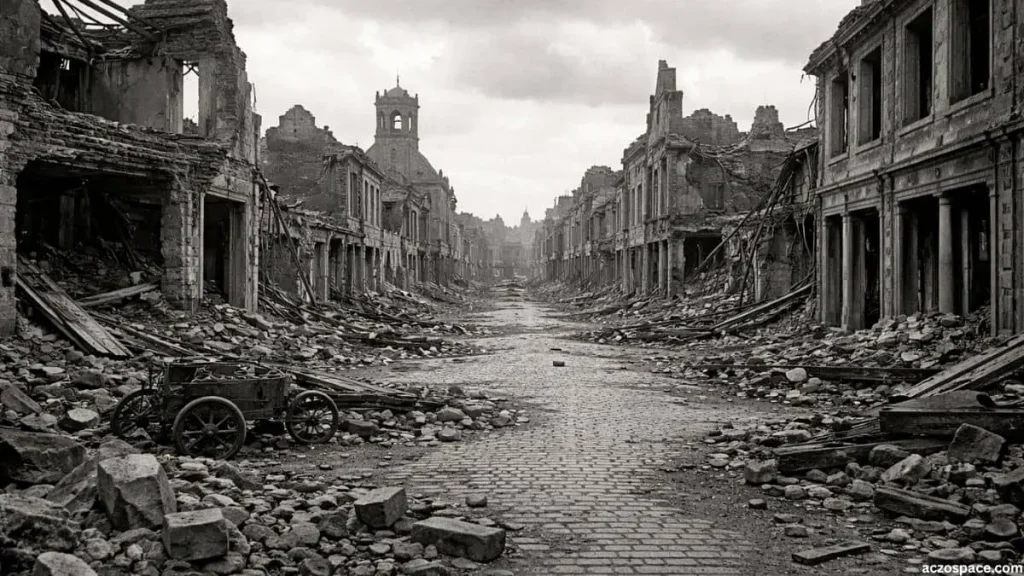
While World War I had some positive legacies, the negative consequences were far greater. The war left behind destruction, human suffering, economic collapse, and political turmoil that shaped the 20th century in devastating ways.
Massive Human Losses
World War I was one of the deadliest conflicts in history.
Around 20 million people died, including 10 million soldiers and 10 million civilians. More than 21 million were wounded, many left disabled for life.
Entire generations of young men in Europe were lost, leading to a “lost generation” of families and communities. The psychological trauma, known then as “shell shock” (today recognized as PTSD), haunted millions of survivors.
Widespread Destruction
The war caused immense physical damage.
Cities, towns, and farmlands across France, Belgium, and Eastern Europe were destroyed.
Infrastructure, such as railways, bridges, and factories, was reduced to rubble.
Agricultural production collapsed, leading to food shortages and hunger.
Economic Crisis and Instability
The financial cost of the war was enormous.
European economies were left bankrupt, with nations owing huge debts, especially to the United States.
Germany faced hyperinflation in the 1920s as it struggled to pay reparations under the Treaty of Versailles.
Unemployment and poverty spread across war-torn nations, fueling social unrest.
Political Upheaval
The war toppled old monarchies and empires.
The Austro-Hungarian Empire collapsed, giving birth to new states like Czechoslovakia and Yugoslavia.
The Ottoman Empire disintegrated, with its lands divided between Britain and France under the Sykes-Picot Agreement.
The Russian Empire fell, leading to the Bolshevik Revolution and the creation of the Soviet Union.
The German Empire ended with the abdication of Kaiser Wilhelm II, leading to the unstable Weimar Republic.
Rise of Extremist Ideologies
The harsh conditions after the war created fertile ground for extremism.
In Germany, anger over Versailles and economic collapse fueled the rise of Adolf Hitler and the Nazi Party.
In Italy, disappointment with territorial gains led to the rise of Benito Mussolini and Fascism.
Across Europe, communism gained momentum, especially after the success of the Russian Revolution.
Global Spread of Disease
The movement of troops and poor conditions contributed to the spread of the Spanish Flu (1918–1919), which killed an estimated 50 million people worldwide, far more than the war itself.
Seeds of World War II
Perhaps the most devastating consequence was that World War I failed to create lasting peace.
The Treaty of Versailles left Germany humiliated and resentful.
Border disputes and unresolved conflicts in Europe and the Middle East created long-term instability.
Within just two decades, the world plunged into an even more catastrophic conflict.
Conclusion
World War I (1914–1918) was more than just a military conflict. It was a turning point in world history. What began with the assassination of Archduke Franz Ferdinand developed into a global war fueled by militarism, alliances, imperialism, and nationalism. The involvement of major powers and their colonies transformed the war into a truly worldwide struggle.
The conflict introduced modern military technologies. Political boundaries were redrawn, and several old empires were destroyed. The Treaty of Versailles (1919) attempted to secure peace, but instead, it sowed the seeds of further conflicts. The war contributed to advances in technology, medicine, women’s rights, and international cooperation. It also left behind destructive losses: millions of lives were lost, economies were devastated, and extremist ideologies emerged.
The legacy of the First World War is still highly relevant today. It teaches us the dangers of unchecked nationalism, militarism, and political arrogance. It also reminds us of the importance of state diplomacy, international cooperation, and peacebuilding.

Although largely overshadowed by the Second World War, the Great War fundamentally changed the course of the 20th century. Its causes, events, and consequences provide valuable lessons to leaders, historians, and citizens around the world.
FAQs
What were the main causes of World War I?
World War I was caused by militarism, rival alliances, imperial competition, rising nationalism, and the assassination of Archduke Franz Ferdinand in 1914.
Which countries were involved in World War I?
Major participants included Germany, Austria-Hungary, the Ottoman Empire, Britain, France, Russia, Italy, the United States, and several smaller nations and colonies.
What was the Treaty of Versailles?
The Treaty of Versailles was a 1919 peace agreement that officially ended World War I, imposed penalties on Germany, and created the League of Nations.
What were the long-term effects of World War I?
World War I led to the collapse of empires, redrew political borders, advanced technology and medicine, and contributed to the outbreak of World War II.