
African music is more than sound. It is woven into daily life, shaping identity and expressing emotions, spiritual beliefs, and collective purpose across the continent.
From the dry sands of the Sahara to the dense forests of the Congo Basin, music has long connected generations. Through songs, rhythms, and dances, elders pass down ancient stories and wisdom to the young, preserving history long before written records existed.
While Western music often prioritizes entertainment and performance, traditional African music usually serves a deeper purpose. It accompanies every major life event—births, weddings, initiation rites, conflict, mourning, and communal celebrations. Each rhythm and drumbeat is believed to carry spiritual meaning. Many communities see music as a bridge between the living, their ancestors, and the spiritual world.
Africa’s vast ethnic and cultural diversity has produced an extraordinary range of musical traditions. Thousands of ethnic groups have shaped unique styles, instruments, and rhythmic patterns. For example, the djembe drumming traditions of West Africa, the melodic kora music of Senegal, and the energetic dance songs of southern Africa all reflect strong connections to community life. In many regions, music is not optional—it is inseparable from daily existence.
Table of Contents
Quick Facts
| Fact | Detail |
| Topic | Traditional African Music |
| Cultural Importance | Integral to daily life, ceremonies, and heritage across Africa |
| Rhythm Focus | Polyrhythmic beats (multiple rhythms at once) |
| Core Instruments | Drums (djembe, talking drum), string instruments (kora, mbira), wind & percussion |
| Spiritual Role | Connects people with community, nature, spirits, and ancestors |
| Regional Variations | West, East, Central, Southern, North Africa each with unique styles |
| Call‑and‑Response Style | Common performance technique enhancing community participation |
| Influence on Global Music | Shaped jazz, blues, reggae, Afrobeat and more |
| Materials Used | Natural materials: wood, animal skin, bone, metal |
| Social Functions | Birth, marriage, work, war, funerals, and daily life celebrations |
As we move from daily life into the roots of tradition, exploring the instruments, rhythms, and cultural settings of traditional African music reveals its ancient power and lasting influence. These traditions laid the foundation for global music genres such as jazz, blues, reggae, and Afrobeat. Even today, traditional African music remains a powerful force, shaping life across the continent and influencing music worldwide.
Historical Roots of Traditional African Music
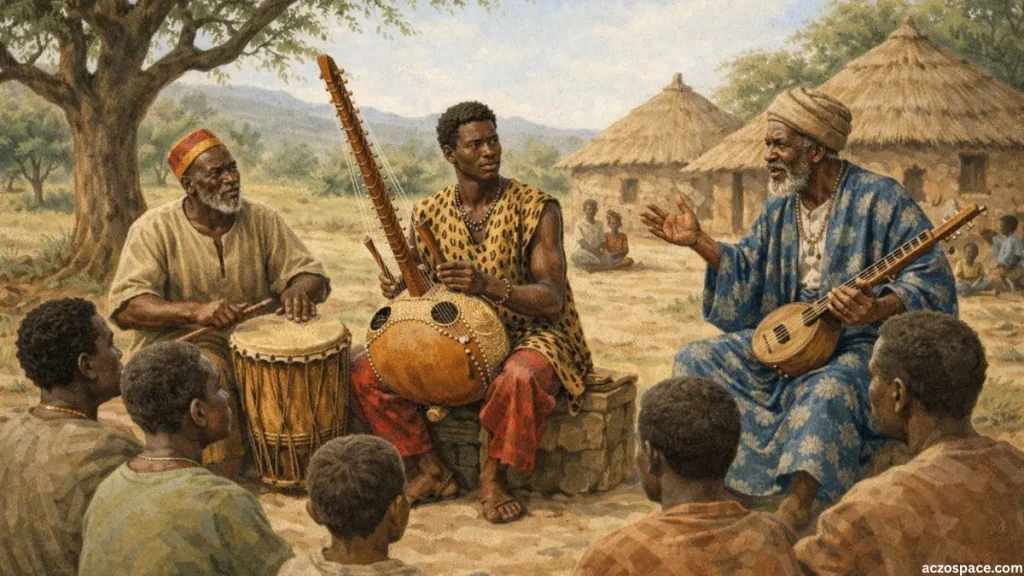
Traditional African music dates back to ancient times, long before the development of writing or modern musical instruments. It was never just a form of entertainment; it was a vital part of how people lived, communicated, and understood their world. Music allowed communities to express thoughts, emotions, and shared experiences, with rhythms and melodies passed down through generations.
Before written language became widespread, African history was preserved through oral traditions. Songs and chants played a central role in this process. They carried heroic tales, moral lessons, genealogies, and tribal laws from one generation to the next. A drum rhythm or flute melody could be just as powerful as spoken words.
In West Africa, specialized musicians known as griots held this responsibility. Often described as historians, poets, and musicians, griots served as the guardians of memory. Through performance, they preserved the heritage of kingdoms, families, and entire communities.
Music also played a crucial role in communication. In parts of West Africa, “talking drums” were designed to imitate the tones of human speech. These instruments allowed messages to travel across long distances—calling villagers to meetings, warning of danger, or celebrating victories. Farmers, warriors, and village elders relied on these musical signals in everyday life.
African musical traditions were strongly shaped by geography and lifestyle. In forest regions, wooden instruments such as xylophones and lamellophones (often called thumb pianos) were common. In drier regions, wind instruments made from animal horns were widely used. Despite these regional differences, music everywhere remained closely tied to spiritual life, work, and social interaction.
The origins of African music are deeply rooted in ancient civilizations and oral traditions. Although centuries have passed, these traditions have never disappeared. Through drumming, singing, and dance, they continue to live on today. Even in the face of empires, migration, and outside influences, Africa’s musical heritage has endured. Its rhythms still echo in the continent’s collective memory—and far beyond its borders.
Rhythm and Musical Structure
Traditional African music is built around rhythm. Rhythm provides the constant pulse that gives the music its energy and direction. In many African cultures, rhythm is more than a musical element—it is closely connected to life itself. It reflects human movement, spiritual belief systems, daily labor, and even the natural rhythms of the world, such as seasons and the beating of the human heart.
One of the most distinctive features of African music is polyrhythm, the use of multiple rhythms played simultaneously. These overlapping rhythmic patterns create rich and dynamic layers of sound. A skilled drummer can combine several rhythmic lines at once, producing what feels like a single, unified groove. This complexity encourages interaction, drawing performers and listeners into a shared musical experience.
Another defining characteristic is the call-and-response style. A lead singer or drummer introduces a phrase, and the group answers in return. This musical dialogue strengthens unity and participation, ensuring that everyone present becomes part of the performance. Call-and-response can be heard during festivals, dances, rituals, and even informal gatherings, reinforcing music’s role as a communal activity rather than a solo performance.
Repetition also plays a central role in African music. Rhythms and melodic phrases are repeated continuously, creating a hypnotic and deeply immersive effect. This repetition allows listeners to lose themselves in the music and reflects a cyclical view of time—one that sees life as a continuous flow rather than a straight line. Through repetition, music becomes meditative and spiritually meaningful.
Rhythmic styles vary across the African continent. West African music is known for its fast, powerful drumming and intricate rhythms, while East African traditions often emphasize melody and movement. Despite these regional differences, rhythm remains the unifying force that connects all African musical traditions.
Traditional African Musical Instruments
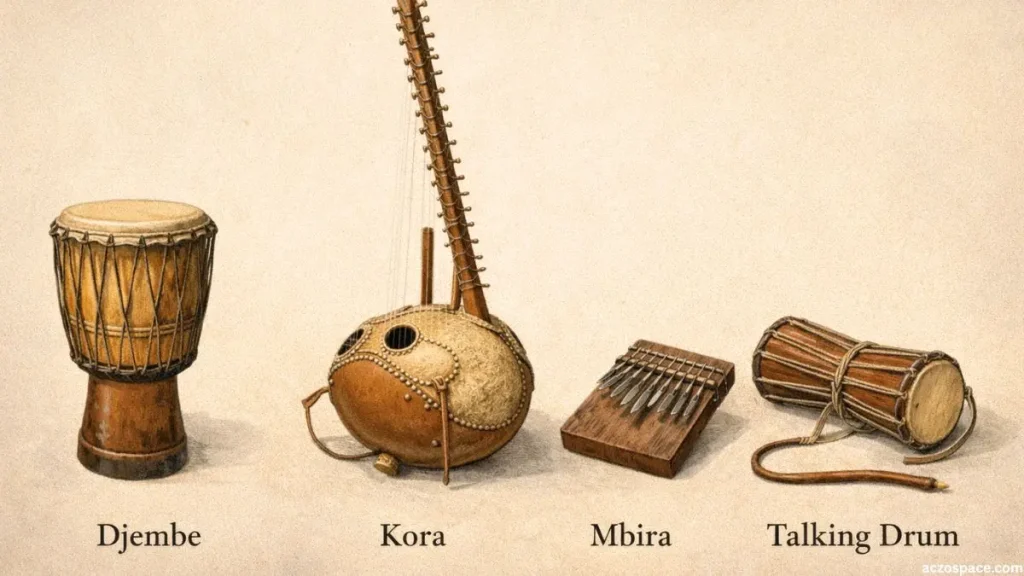
Africa’s musical heritage is inseparable from its instruments. These instruments are not only used to create music but also to communicate, teach, and tell stories. Drums, string instruments, wind instruments, and vocal sounds all carry meaning. Every beat and every breath holds cultural significance.
Most traditional African instruments are made from natural materials such as wood, animal skin, bone, metal, and gourds. This reflects the deep relationship between African communities and the natural world. Music and nature are not separate; they exist as interconnected parts of daily life.
These instruments are essential to traditional African music and are used in ceremonies, religious rituals, celebrations, and everyday activities. Through their continued use, they help preserve cultural knowledge and pass traditions from one generation to the next.
Drums: The Voice of the People
Drumming stands at the heart of African music. Drums are more than musical tools; in many communities, they are considered sacred voices. Often referred to locally as “the people’s voice,” drums are used to communicate, unite, and guide communities. Their sound brings people together during festivals, religious ceremonies, and social gatherings.
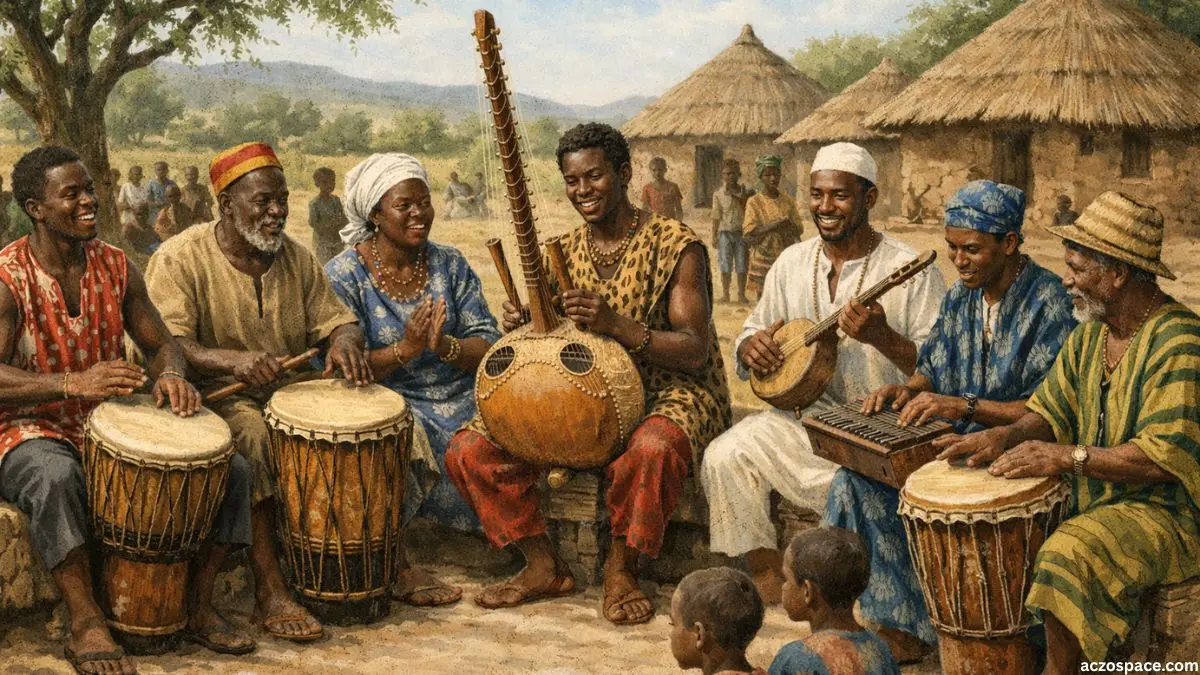
One of the most famous African drums is the djembe, originating in West Africa. Carved from a single piece of hollowed wood and covered with stretched animal skin, the djembe can produce a wide range of tones—from deep bass sounds to sharp, high-pitched slaps. It is commonly used in celebrations, dance performances, and healing rituals.
Another important instrument is the talking drum, also known as the dundun. This drum can mimic the pitch and rhythm of human speech. In ancient times, it was used to send messages between villages, announce events, and warn of danger. In this way, it functioned as a musical language.
In Central and Southern Africa, the ngoma drum plays a key role in social and spiritual ceremonies. Its rhythms accompany dances, rites of passage, and healing practices. Together, these drums demonstrate the diversity and cultural depth of African musical traditions.
String Instruments: Melodies of the Soul
String instruments also play a vital role in African music, providing melody and emotional depth. They are often used for storytelling, praise songs, and historical narration. In West Africa, griots—traditional historians and musicians—commonly play the kora, a harp-like instrument with 21 strings. Its gentle, flowing sound evokes memory, spirituality, and the presence of the past.
The mbira, often called the thumb piano, is widely used in Zimbabwe and Mozambique. It consists of metal keys attached to a wooden board and produces a bright, resonant tone. In many traditions, the mbira is believed to connect the living with ancestral spirits and is frequently played during spiritual ceremonies.
Other notable string instruments include the salam, a type of lute found in parts of Africa, and the inanga, a traditional Rwandan zither. Together, these instruments highlight the continent’s rich musical diversity and its commitment to preserving cultural heritage.
Wind and Percussion Instruments: Sounds of Nature
Wind instruments are an important part of African music and are often made from bamboo, bone, reeds, or animal horns. Pipes and whistles are commonly played during harvest festivals, rituals, and traditional dances. Their sounds echo the natural environment, symbolizing humanity’s connection to the land.
Percussion instruments such as shakers, rattles, and bells add texture and rhythm to performances. These instruments often imitate natural sounds like rain, wind, or animal movement, bringing life and motion to the music.
Together, drums, strings, wind, and percussion instruments create a powerful soundscape that reflects Africa’s landscapes and spiritual energy. Each instrument tells a story, reminding listeners that African music is not just something to hear—but something to experience deeply.
The Cultural and Social Roles of Music in Africa
In Africa, music is far more than simple entertainment. It is a powerful way for communities to express their collective spirit and understand their place in the world. Every rhythm, song, and dance not only brings enjoyment but also connects moments of human life with nature and spirituality.
Music accompanies Africans from birth to death and plays different roles at every stage of life:
- Birth celebrations: Joyful songs welcome newborns into the community and bless them with hopes for a healthy future.
- Weddings: Rhythm and dance unite families, celebrating love, continuity, and social harmony.
- Funeral rites: Slow, emotional songs guide the departed soul and help the living express grief, remembrance, and respect.
- Daily life: Farmers sing while working the fields, fishermen use rhythm while rowing, and women incorporate music into household and communal tasks.
- Group labor: When people work together, shared rhythms and unified voices reduce physical strain, strengthen cooperation, and turn labor into a collective, even joyful, experience.
African music is also deeply spiritual. Songs and rhythms are often used to communicate with ancestral spirits or divine forces. During traditional ceremonies, drumming and chanting can lead participants into trance-like states, creating profound spiritual experiences that blur the line between the physical and spiritual worlds.
Another vital role of music is the preservation of cultural identity. Every ethnic group has its own musical styles, lyrics, and dances. Through oral traditions, music protects historical memory and helps younger generations learn about the lives, values, and struggles of their ancestors.
From the heroic songs of the Zulu to Yoruba praise poetry to the famous jumping dances of the Maasai, African music reflects geography, lifestyle, and ancestry. Across the continent, music remains inseparably linked to spirituality, social life, and everyday human experience.
Regional Styles of Traditional African Music
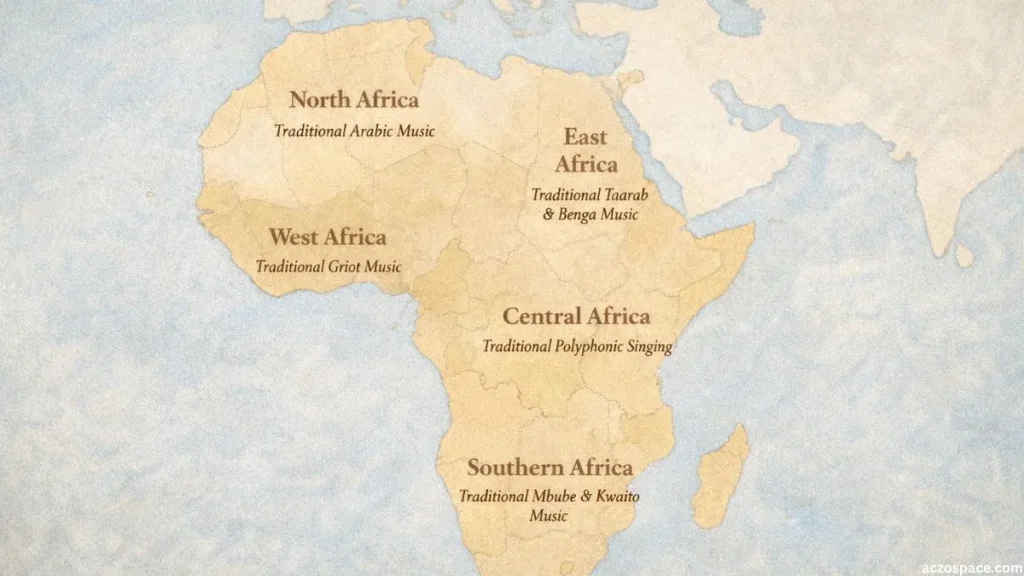
Africa’s immense size and diversity are reflected in its music. Thousands of ethnic groups, languages, and traditions have shaped regional musical styles influenced by geography, climate, and history. While the forms may differ, rhythm remains the shared foundation across the continent. Traditional African music has evolved differently in each region, highlighting its deep connection to social life and cultural context.
West Africa: The Home of the Drum
The rhythmic heart of African music is often found in West Africa. Countries such as Mali, Senegal, Guinea, and Nigeria are renowned for their rich drumming traditions and the storytelling art of griots. Instruments like the djembe, kora, and balafon form the backbone of the region’s music.
These musical traditions have long been used to record royal histories, honor ancestors, and pass down wisdom through song. West African music is especially known for its energetic dance styles and complex rhythmic patterns, making it one of the most influential African sound traditions worldwide.
East Africa: The Land of Melody and Movement
East African music places strong emphasis on melody and dance. In countries such as Kenya, Tanzania, and Uganda, instruments like lyres, mbiras, and drums are commonly used to create lively and expressive songs. Traditional festivals often feature graceful dance movements paired with call-and-response singing.
Along the coast, Swahili music reflects centuries of interaction between African and Arab cultures. Its intricate rhythms and melodic patterns reveal influences from the Indian Ocean trade routes. In this region, music serves as a powerful means of communication, celebration, and cultural expression.
Central Africa: Voices of the Rainforest
Central African music is famous for its complex vocal polyphony. Communities living in the Congo Basin, including Pygmy groups, create layered vocal music that mirrors the sounds of the rainforest. Their songs often imitate birds, insects, rivers, and wind.
Traditional instruments such as wooden xylophones, rattles, and drums support these performances. For many forest communities, music is not meant for public display but for shared participation, closely tied to nature and daily life.
Southern Africa: Harmony and Unity
In Southern Africa—particularly in Zimbabwe, Zambia, and South Africa—music emphasizes vocal harmony and rhythmic balance. Instruments such as the marimba, mbira, and berimbau play key roles in traditional performances.
Large vocal ensembles performing layered harmonies are common. These rich, soulful soundscapes create an emotional connection between performers and listeners, reinforcing unity and shared identity.
North Africa: Rhythms of the Desert
North African music blends Berber, Arab, and African influences. It features expressive vocal styles, hand percussion, and instruments such as the oud, shaped by desert rhythms and ancient trade networks. In countries like Morocco, Algeria, and Egypt, Sufi religious music often includes chanting and call-and-response patterns.
This region highlights the vast range of African musical traditions, stretching from arid deserts to fertile coastal regions and forested lands.
Across all regions, the core purpose of traditional African music remains the same: to bring people together, share knowledge, and celebrate life. Through rhythm, harmony, and movement, African music stands as a living testament to the continent’s history, cultural identity, and enduring human connections.
Influence on Contemporary Global Music
Traditional African music has had a profound and lasting influence on musical traditions around the world. Rhythms, vocal styles, and spiritual depth that emerged centuries ago continue to shape many modern genres. The driving pulse, layered textures, and emotional intensity found in blues, jazz, reggae, gospel, hip-hop, and Afrobeat can all be traced back to African musical foundations.
During the era of the transatlantic slave trade, enslaved Africans carried their musical knowledge across the Atlantic. Even under brutal conditions, they preserved essential elements such as call-and-response singing, rhythmic clapping, expressive vocals, and deep emotional storytelling. In the Americas, these traditions blended with European instruments and harmonic systems, giving rise to entirely new musical forms.
In the southern United States, African work songs and spirituals evolved into the blues, expressing sorrow, hope, endurance, and everyday struggle. These musical forms later influenced early folk traditions and helped shape the roots of American popular music. From these foundations, new styles continued to emerge.
Jazz, which developed in New Orleans, reflects African influence in its emphasis on improvisation, rhythmic freedom, and musical dialogue. These elements closely mirror African performance traditions, where music is spontaneous, interactive, and deeply expressive. Similarly, genres such as reggae in the Caribbean and samba in Brazil draw heavily on African drumming patterns and dance-based musical structures, highlighting the global reach of African rhythm.
In the modern era, Afrobeat, pioneered by Fela Kuti and later revitalized by a new generation, has brought African music back into global focus. By blending traditional rhythms with funk, jazz, highlife, and contemporary sounds, Afrobeat has become both a musical style and a voice for social and political expression. Artists such as Burna Boy, Angélique Kidjo, and Yemi Alade continue to introduce ancient rhythms to global audiences, proving their timeless relevance.
Traditional African music, with its powerful rhythms and expressive depth, remains a gift to the world. While it continues to evolve, its core spirit endures. When a drummer or singer performs with awareness of history and tradition, the full emotional and cultural depth of this music becomes unmistakably clear.
Preservation and the Future of Traditional African Music
Although traditional African music has endured for centuries, it now faces new challenges in a rapidly digital and globalized world. Many local practices risk fading as modern lifestyles and technologies reshape communities. Yet across Africa and beyond, a new generation is actively working to protect, document, and celebrate this invaluable cultural heritage.
Modern technology has become one of the most powerful tools for preservation. Musicians, scholars, and cultural organizations are recording traditional rhythms, instruments, and songs through audio archives, documentaries, and online platforms. These efforts ensure that ancient musical knowledge can be studied and experienced by future generations.
Traditional African music is increasingly taught in schools, universities, and cultural institutions, allowing young people to connect with their heritage in meaningful ways. Live performances and workshops further help keep these traditions alive, not as museum pieces, but as living, evolving art forms.
International organizations such as UNESCO, along with national governments, have recognized the importance of safeguarding Africa’s musical heritage. Musical traditions such as Gnawa from North Africa and Isicathamiya from Southern Africa are now celebrated as global cultural treasures. Written documentation and long-term archival projects provide additional layers of protection.
Young African artists are also playing a vital role in shaping the future of traditional music. By blending ancient rhythms with modern genres, they create bridges between past and present. This fusion allows traditional African music to continue evolving while maintaining its cultural integrity.
As new styles such as Afrobeats gain worldwide popularity, they carry the spirit of traditional African music into the future. Its rhythm, complexity, and emotional power remain strong, ensuring that this musical heritage will continue to inspire generations to come.
Conclusion
Traditional African music remains a constant rhythm of life, both within local communities and far beyond them. It gives voice to ancestral memory, inspires dancers and storytellers, and continues to shape the sound of global music. Every rhythm, melody, and dance step tells an African story—one rooted in unity, identity, and the human spirit.
Despite cultural differences and changing social systems around the world, African music stays deeply connected to its origins. It preserves powerful links to nature, history, and human relationships that have endured for centuries. Whether performed beneath a baobab tree in a rural village or shared with millions on a global stage, African music carries the same message: rhythm unites people, harmony strengthens community, and music itself is a universal expression of human connection.
This enduring tradition reminds us that African music is not simply something to be heard—it is something to be lived, remembered, and passed on.
FAQs
What are traditional African musical instruments?
Traditional instruments include drums like the djembe, the mbira, kora, and African flutes made from natural materials.
How does African music influence modern genres?
African rhythms and instruments shaped blues, jazz, reggae, hip-hop, and Afrobeat.