
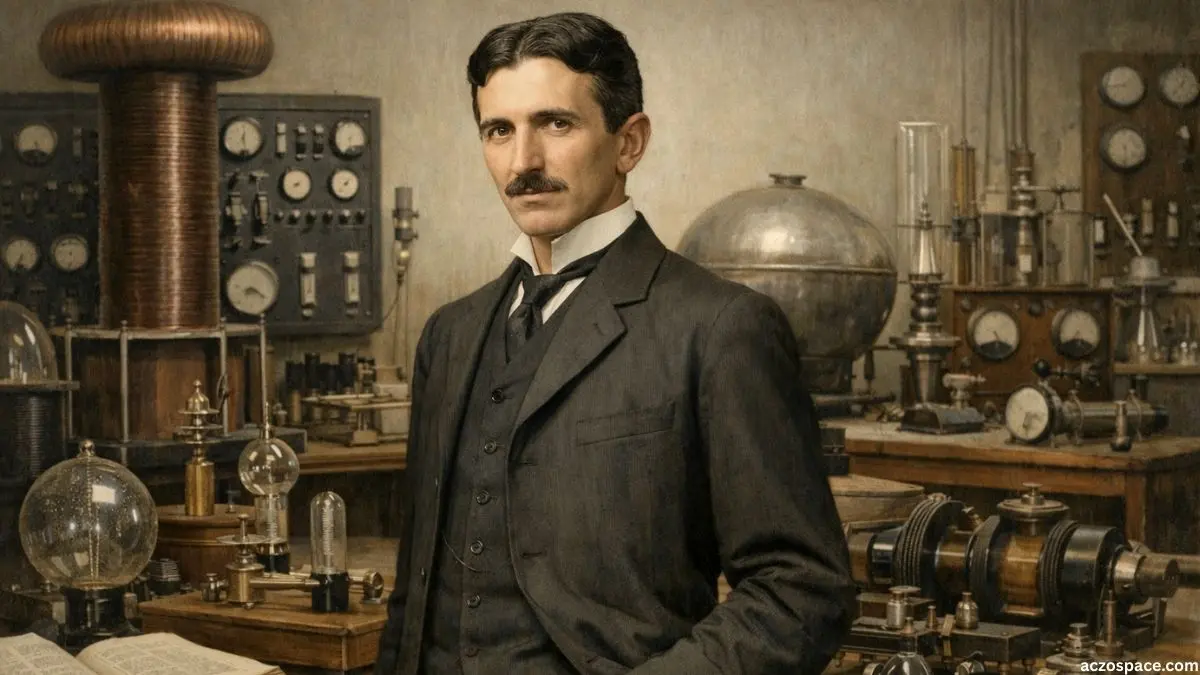
Nikola Tesla was a far-sighted inventor and electrical engineer whose ideas transformed modern science and technology. His groundbreaking research into electricity revolutionized the way power is generated and distributed, while his work on magnetism and wireless communication opened entirely new scientific pathways. Many of the technologies we rely on today—from power grids to radio systems—are built on foundations Tesla helped establish.
Among his most influential contributions was the development of alternating current (AC) systems, which remain the global standard for electrical power transmission. His famous Tesla Coil, still used in scientific demonstrations and radio technology, stands as another symbol of his inventive genius. Together, these innovations played a major role in shaping modern civilization.
Despite his extraordinary intellect, Tesla’s life was far from easy. He faced persistent personal struggles and serious financial difficulties throughout his career. Yet his legacy has endured. Today, Tesla continues to inspire engineers, scientists, and innovators around the world.
Table of Contents
Tesla’s story is not only about science—it is a powerful testament to imagination, perseverance, and an unwavering commitment to progress. This biography explores his life from birth to death, examining his major inventions, the challenges he faced, and the lasting impact of his work.
Quick Facts
| Fact | Detail |
| Full Name | Nikola Tesla |
| Born | July 9/10, 1856, Smiljan, Austrian Empire (now Croatia) |
| Died | January 7, 1943, New York City, USA |
| Nationality | Serbian‑American inventor & engineer |
| Major Contribution | Development of alternating current (AC) electrical system |
| Famous Inventions | Tesla coil, AC motors & transformers |
| Education | Studied in Graz (Austria) and Prague universities |
| Work in USA | Immigrated in 1884, worked with Edison & Westinghouse |
| Notable Experiment | Wireless power transmission & Wardenclyffe Tower project |
| Legacy | Foundation of modern electric power and wireless communication |
Early Life and Family Background
Nikola Tesla was born on July 10, 1856, in the village of Smiljan, then part of the Austrian Empire and now located in modern-day Croatia. His father, Milutin Tesla, was a Serbian Orthodox priest as well as a writer. His mother, Georgina “Đuka” Tesla, had no formal education, yet she possessed remarkable inventive talent. She designed and built small household tools and mechanical devices, and Tesla often credited her as the source of his mechanical intuition.
Tesla grew up with four siblings—Dan, Angelina, Milka, and Marica. From an early age, he displayed exceptional intellectual abilities, including an extraordinary memory and powerful visualization skills. Family accounts describe how he could perform complex calculations entirely in his head and recall entire books after a single reading—early signs of the brilliant inventor he would become.
Childhood and Education
Tesla’s childhood was shaped by curiosity, intellectual challenge, and contrasting parental expectations. While his father hoped he would enter the priesthood, his mother strongly encouraged his inventive interests.
A pivotal moment occurred when Tesla witnessed a demonstration of an electrical machine during his school years. The experience sparked a lifelong fascination with electricity and set him on the path toward electrical engineering.
He later attended the Higher Real Gymnasium in Karlovac, where he excelled in mathematics, physics, and languages. During this period, Tesla reported experiencing vivid mental images of inventions—devices that appeared fully formed in his mind before he ever attempted to build them. This rare ability, often described as eidetic visualization, allowed him to mentally test and refine designs with remarkable precision.
In 1875, Tesla enrolled at the Austrian Polytechnic in Graz to study electrical engineering. There, he made significant progress in understanding alternating current systems. According to Tesla’s later accounts, it was while walking through the city that he first conceived the rotating magnetic field—a fundamental principle behind AC motors. This insight would later become one of his most important contributions to electrical engineering.
Early Career and First Inventions
After leaving Graz, Tesla worked briefly at a telegraph company in Budapest, where he began experimenting with electrical and magnetic devices. One of his early and most striking achievements was the development of a remotely controlled boat, which he publicly demonstrated in 1898. This invention, known as a “teleautomaton,” is widely regarded as a precursor to modern robotics and wireless control systems.
Tesla also worked for the Continental Edison Company in Paris, where he gained valuable hands-on experience designing electrical equipment. Exposure to real-world engineering challenges helped him refine his ideas and strengthen his confidence as an innovator. These experiences ultimately paved the way for his move to the United States—an event that would mark the beginning of the most famous and productive phase of his career.
Journey to the United States

In 1884, Nikola Tesla arrived in New York City with little more than a suitcase and a single letter of introduction. That letter contained a now-famous line: “I know two great men. One is you. The other is this young man.” It was addressed to Thomas Edison, and Tesla personally delivered it.
Soon after, Tesla began working for Edison, focusing on improving direct current (DC) electrical systems. At the time, DC power was the backbone of Edison’s growing electrical empire. Tesla proved himself to be a highly capable engineer, quickly redesigning generators and solving complex technical problems. However, Tesla’s long-term vision differed sharply from Edison’s. He believed that alternating current (AC) was far more efficient for transmitting electricity over long distances. This fundamental disagreement laid the groundwork for what would later become known as the famous “War of Currents”—a battle not only of technology, but of business interests and public perception.
Working with Thomas Edison and the AC/DC Debate
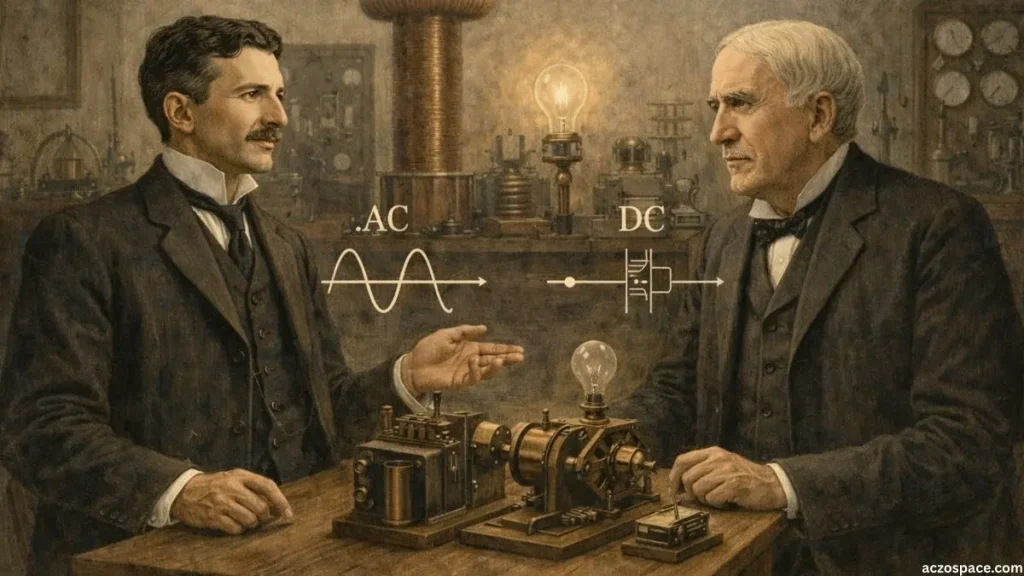
Tesla worked as a key technical assistant on Edison’s machinery, significantly improving DC generators. Despite his successes, Tesla later claimed that Edison refused to pay him a promised $50,000 bonus for his work—an incident that ultimately led Tesla to resign.
While Edison was a brilliant inventor and an even sharper businessman, Tesla later remarked that Edison lacked vision when it came to alternating current. Edison remained firmly committed to DC power, while Tesla saw AC as the future.
That future took shape when Tesla partnered with industrialist George Westinghouse, who immediately recognized the potential of AC systems. Together, they demonstrated the superiority of alternating current at the 1893 World’s Columbian Exposition in Chicago. The fair was illuminated using AC power, marking the first large-scale public display of AC electricity and capturing worldwide attention.
One of Tesla’s greatest triumphs followed soon after: the successful implementation of AC power at the Niagara Falls hydroelectric project. This achievement revolutionized electricity generation and distribution, proving that power could be transmitted efficiently to distant cities. It became a turning point in global electrification and solidified AC as the dominant power system worldwide.
Major Inventions and Contributions
Nikola Tesla’s genius extended far beyond theory. He was a practical innovator whose inventions reshaped technology itself. His work spanned alternating current systems, electric motors, wireless communication, and high-frequency devices. Below are some of his most important contributions.
Alternating Current (AC) Power System
Tesla’s development of the alternating current system was nothing short of revolutionary. Unlike direct current, which suffered major power losses over distance, AC could be transmitted efficiently across hundreds of miles.
Tesla invented a complete polyphase AC system, including generators, transformers, and induction motors. During the “War of Currents,” AC ultimately defeated DC and became the global standard for electrical power transmission—a status it still holds today. Tesla’s system laid the foundation for modern electrical grids across the world.
The Tesla Coil
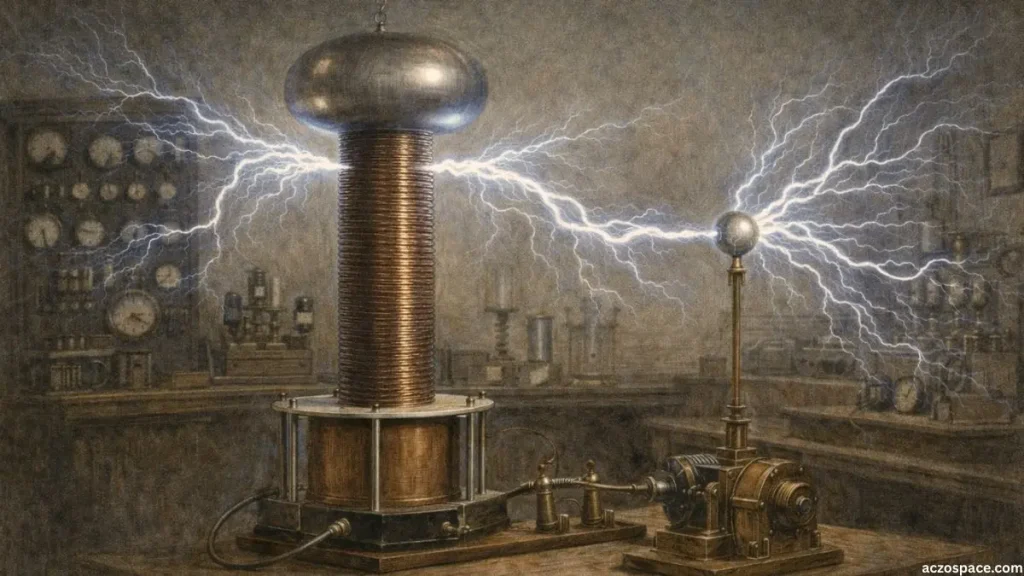
Invented in 1891, the Tesla Coil is a high-voltage, high-frequency transformer capable of producing dramatic electrical discharges. While visually spectacular, it was far more than a scientific curiosity.
Tesla Coils played a crucial role in early radio technology, medical equipment, and experimental physics. Tesla used them to explore wireless power transmission and to push the limits of electrical energy. Visitors to his laboratories often witnessed intense sparks and lightning-like arcs—a sight that helped build his legendary reputation.
The Induction Motor
Tesla’s AC induction motor used a rotating magnetic field to produce mechanical motion without direct electrical contact. This breakthrough dramatically improved efficiency and reliability in industrial machinery.
The induction motor transformed factories, enabling pumps, fans, and heavy equipment to operate smoothly and economically. Remarkably, the same basic design remains at the core of many modern electric motors today.
Wireless Power Transmission
Tesla envisioned a world where electricity could be transmitted wirelessly, without cables or wires. During his experiments in Colorado Springs, he generated massive electrical oscillations, lit lamps from a distance, and transmitted signals through the Earth itself.
His most ambitious effort was the Wardenclyffe Tower, designed to enable global wireless communication and power transmission. Although the project was never completed due to financial constraints, Tesla’s experiments laid the groundwork for radio, Wi-Fi, and modern wireless power concepts.
Other Notable Innovations
- Radio Communication: Long before Guglielmo Marconi’s famous demonstrations, Tesla had already proven key principles of wireless communication. He was later granted legal recognition as a pioneer of radio technology.
- Remote Control: In 1898, Tesla publicly demonstrated a radio-controlled boat, marking one of the earliest examples of robotics and automation.
- Electric and Neon Lighting: Tesla improved lighting systems using high-frequency lamps, influencing the development of modern illumination technologies.
- X-ray Research: Tesla conducted early experiments with X-ray imaging and built some of the first radiation-generating devices, contributing to the early understanding of medical imaging.
Later Years and Personal Life
Nikola Tesla’s later years were marked by a striking contrast between intellectual brilliance and personal isolation. Despite his immense contributions to science and engineering, he struggled financially for much of his life. Tesla spent his later decades living in New York City hotels, frequently moving from one to another as unpaid bills accumulated. Over time, his debts became increasingly difficult to manage.
While his ideas continued to reach far beyond his era, the world around him began to move on, often failing to recognize the value of his ongoing work.
Personality and Habits
Several distinctive personality traits contributed both to Tesla’s extraordinary achievements and to his unconventional lifestyle:
- Tesla was widely known for his eccentric behavior.
- He possessed an exceptional memory, often described as photographic.
- He slept only a few hours each night, believing sleep reduced productivity.
- He followed a rigid daily routine and was highly disciplined in his work habits.
- Tesla preferred solitude and avoided crowded social environments.
- He displayed obsessive and compulsive tendencies, including a fixation on the number three.
Tesla never married and devoted his entire life to science. He believed romantic relationships would distract him from his work. While this intense dedication contributed to his social isolation, he maintained friendships with prominent figures of his time, including the writer Mark Twain, who admired Tesla’s intellect and originality.
Financial Struggles and Ongoing Challenges
Despite his genius, Tesla faced continuous financial hardship. Many of his inventions were far ahead of their time, making it difficult to secure consistent funding. Investors often lost patience when large-scale projects—such as the ambitious Wardenclyffe Tower—failed to produce immediate financial returns.
In his final decades, Tesla focused on highly visionary concepts, including wireless electricity, advanced energy transmission, and theoretical defensive technologies. Although these ideas captured public curiosity, none achieved commercial success during his lifetime. As a result, Tesla increasingly lived on the margins of the scientific and business communities he had once helped shape.
Death and Legacy
Nikola Tesla died on January 7, 1943, at the age of 86, alone in his hotel room in New York City. At the time of his death, much of his extraordinary contribution to modern technology remained underappreciated by the general public.
In the decades that followed, however, Tesla’s reputation grew dramatically. Today, he is widely celebrated as one of the greatest inventors in history. His ideas form the foundation of countless modern technologies, from electrical power systems to wireless communication. Once overlooked, Tesla is now recognized as a visionary whose imagination and perseverance helped define the modern world.
Impact on Modern Technology

Nikola Tesla’s inventions played a foundational role in shaping the modern world, particularly in the fields of electricity, wireless communication, and energy systems. His influence can be seen across several key areas:
- Electrical Power: Alternating current (AC) systems and electric motors—developed from Tesla’s original designs—continue to supply power to homes, factories, and cities across the globe.
- Wireless Technology: Tesla’s early experiments laid the groundwork for radio transmission, Wi-Fi, and modern wireless communication networks.
- Electric Vehicles: Today, the name “Tesla” has become synonymous with electric vehicles, symbolizing innovation, energy efficiency, and a shift toward sustainable transportation.
- Medical Technology: Tesla’s research into high-frequency currents and imaging techniques helped establish early foundations for modern medical devices and diagnostic technologies.
Honor and Recognition
Although Tesla faced significant struggles during his lifetime, his recognition and influence grew enormously after his death.
- Scientific Units: The SI unit of magnetic flux density, the tesla (T), is named in his honor.
- Museums and Institutions: Organizations such as the Nikola Tesla Museum in Belgrade preserve his work, personal belongings, and scientific legacy.
- Cultural Recognition: Tesla is widely celebrated as a symbol of innovation and intellectual brilliance in films, books, and popular media.
Popular Culture and Continuing Influence
Tesla’s life and inventions continue to inspire engineers, scientists, and innovators around the world.
- Films and Documentaries: Movies such as The Prestige and numerous documentaries explore his mysterious personality and visionary ideas.
- Books: Biographies and science history books frequently highlight Tesla’s contributions to electricity and technological progress.
- Companies and Innovation: Tesla, Inc., founded by Elon Musk, pays tribute to Tesla’s forward-thinking vision by focusing on sustainable energy and advanced transportation technologies.
Conclusion
Nikola Tesla’s life reflects extraordinary intelligence, relentless determination, and visionary thinking. His work laid the foundation for modern electrical systems, wireless communication, and countless technological innovations that define everyday life today.
Tesla’s story reminds us that true innovation often arises from bold imagination and unwavering dedication—even when recognition comes late or not at all. Today, Nikola Tesla stands as a symbol of human potential and remains a lasting source of inspiration for inventors, scientists, and dreamers across the world.
FAQs
How did Nikola Tesla die?
Nikola Tesla died on January 7, 1943, in New York City at the age of 86, from coronary thrombosis (a heart-related condition).
How did Nikola Tesla impact the world?
Nikola Tesla revolutionized the world with his inventions, especially in electricity and wireless technology. He developed alternating current (AC) power, which became the foundation of modern electrical systems, and his visionary ideas in radio, wireless transmission, and renewable energy continue to influence technology today.