
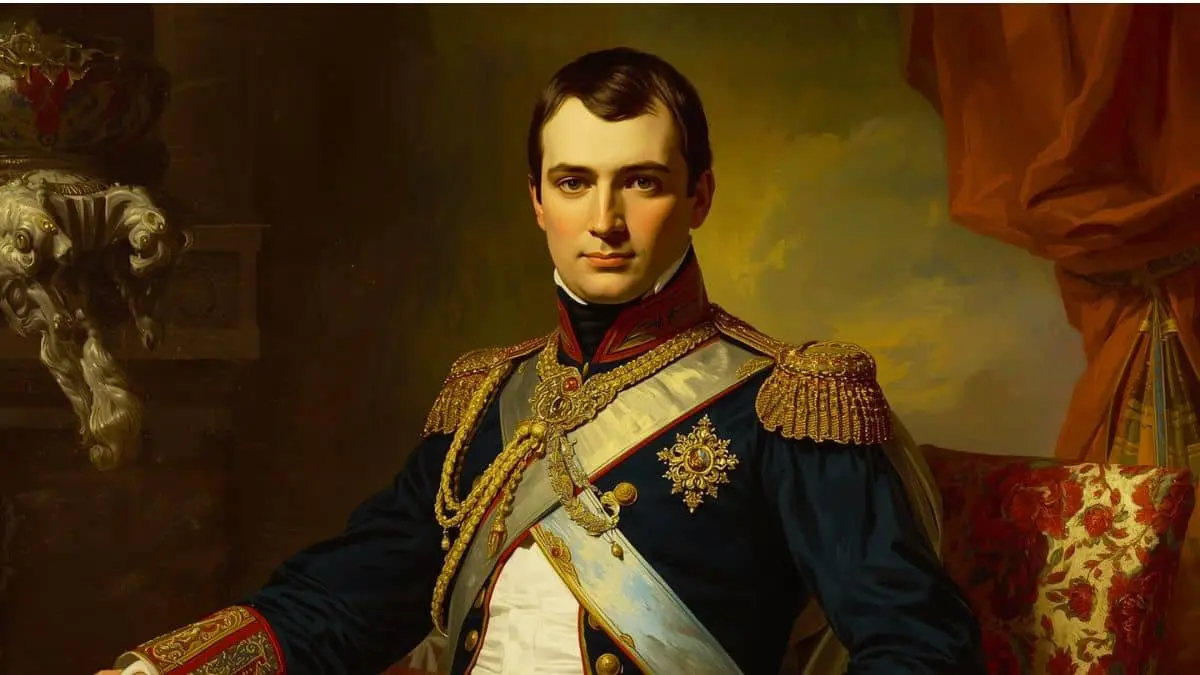
Few figures in world history have left a mark as powerful and complex as Napoleon Bonaparte. Rising from modest beginnings to become the Emperor of France, Napoleon transformed the political and military landscape of Europe in the early 19th century. Known for his brilliant military strategies, bold leadership, and ambitious reforms, he became one of the most influential leaders the world has ever seen.
Napoleon’s journey is remarkable. Born on the island of Corsica, he began his career as a young artillery officer during the turmoil of the French Revolution. Through intelligence, determination, and a series of stunning military victories, he quickly rose through the ranks of the French army. Eventually, he seized political power and crowned himself Emperor, building an empire that dominated much of Europe.
However, Napoleon’s story is not only about victory and power. His reign also included dramatic setbacks, fierce wars, and an eventual downfall that reshaped European politics. Despite his defeat, the impact of his leadership, military tactics, and legal reforms continues to influence modern societies.
In this article, we will explore the fascinating life of Napoleon Bonaparte, including:
- His early life and background
- His rise to political power
- His major military achievements
- His dramatic fall from power
- And the lasting legacy he left on world history.
By understanding Napoleon’s life and legacy, we gain deeper insight into one of the most extraordinary and controversial leaders in history.
Table of Contents
Quick Facts
| Fact | Details |
| Full Name | Napoleon Bonaparte |
| Born | August 15, 1769 |
| Birthplace | Corsica |
| Nationality | French |
| Famous Role | Emperor of France |
| Years in Power | 1799 – 1814, briefly in 1815 |
| Major Wars | Napoleonic Wars |
| Famous Victory | Battle of Austerlitz (1805) |
| Famous Defeat | Battle of Waterloo (1815) |
| Legal Reform | Napoleonic Code |
| Exile Location | Saint Helena |
| Died | May 5, 1821 |
Early Life of Napoleon Bonaparte
Birth and Childhood in Corsica
Napoleon Bonaparte was born on August 15, 1769, on the Mediterranean island of Corsica. His birth came just a year after the island officially became part of France, following years of conflict and political change. This unique historical moment shaped Napoleon’s early identity, as he grew up between Corsican traditions and French political influence.
Napoleon was born into a relatively modest but respected family. His father, Carlo Buonaparte, was a lawyer and local political figure who supported Corsican independence before later aligning with French authorities. His mother, Letizia Ramolino, was known for her discipline and strong character, qualities that influenced Napoleon’s determined personality.
The Bonaparte family had Italian roots, and their original surname was spelled “Buonaparte.” Corsica itself had long been influenced by Italian culture, particularly from Italy and the nearby city-state of Genoa, which had ruled the island before transferring it to France. Because of this heritage, Napoleon grew up speaking a Corsican dialect closely related to Italian before later learning French.
Napoleon’s childhood was shaped by the political struggles on the island and the ambitions of his family. These early experiences helped develop his strong sense of identity, determination, and desire to achieve greatness.
Education and Military Training
Recognizing his intelligence and potential, Napoleon’s father arranged for him to receive an education in mainland France. At the age of nine, Napoleon left Corsica to attend the military academy at Brienne-le-Château Military School.
Life at the academy was not easy for the young Corsican. He spoke French with a heavy accent and often faced teasing from classmates. However, Napoleon focused intensely on his studies and developed a reputation for being quiet, disciplined, and highly ambitious.
He showed particular talent in mathematics, a skill that proved valuable in artillery and military planning. His strong analytical thinking helped him understand battlefield positioning, logistics, and strategic movements better than many of his peers.
After several years at Brienne, Napoleon continued his training at the prestigious École Militaire in Paris. In 1785, at just sixteen years old, he graduated and was commissioned as a second lieutenant in the French artillery.
This early military education laid the foundation for Napoleon’s future success. His deep understanding of strategy, discipline, and battlefield tactics would later help him become one of the most brilliant and influential military commanders in history.
Napoleon Bonaparte’s Rise to Power
The French Revolution Opportunity
The rise of Napoleon Bonaparte was closely connected to the dramatic events of the French Revolution, which began in 1789. The revolution overturned the traditional monarchy of France, creating political instability and major changes within the government and military.
During this period, many experienced officers from noble families lost their positions or fled the country. As a result, the French army needed new leaders who supported the revolutionary government. This situation created opportunities for talented young officers like Napoleon to rise quickly through the military ranks.
Napoleon first gained national attention during the Siege of Toulon in 1793. By successfully organizing French artillery and helping defeat royalist forces supported by foreign powers, he demonstrated exceptional military skill. His success earned him a promotion to brigadier general at just 24 years old, marking the beginning of his rapid rise in influence.
Early Military Victories
Napoleon’s reputation grew even stronger during the Italian Campaigns of Napoleon. In 1796, the French government placed him in command of the French army in northern Italy.
At the time, the army was poorly supplied and struggling against stronger enemy forces. However, Napoleon used innovative strategies, speed, and careful planning to defeat larger armies from Austria and their allies.
Through a series of remarkable victories, Napoleon forced Austria to sign the Treaty of Campo Formio in 1797. These victories made him a national hero in France and a well-known military leader across Europe. Newspapers and propaganda portrayed him as a brilliant general capable of protecting and expanding French power.
Becoming First Consul
Despite military success abroad, political instability continued in France. The ruling government, known as the French Directory, struggled with corruption, economic problems, and public dissatisfaction.
Sensing an opportunity, Napoleon returned to France and became involved in a political plan to overthrow the government. On November 9, 1799, he carried out the Coup of 18 Brumaire, a carefully organized takeover that replaced the Directory with a new government called the French Consulate.
Following the coup, Napoleon became First Consul, the most powerful position in France. Although the new system appeared to share power, Napoleon quickly became the dominant leader.
This moment marked the transition of Napoleon from a successful general to the political ruler of France, setting the stage for his future coronation as emperor and the expansion of his influence across Europe.
Napoleon Bonaparte as Emperor of France
The Coronation of Napoleon
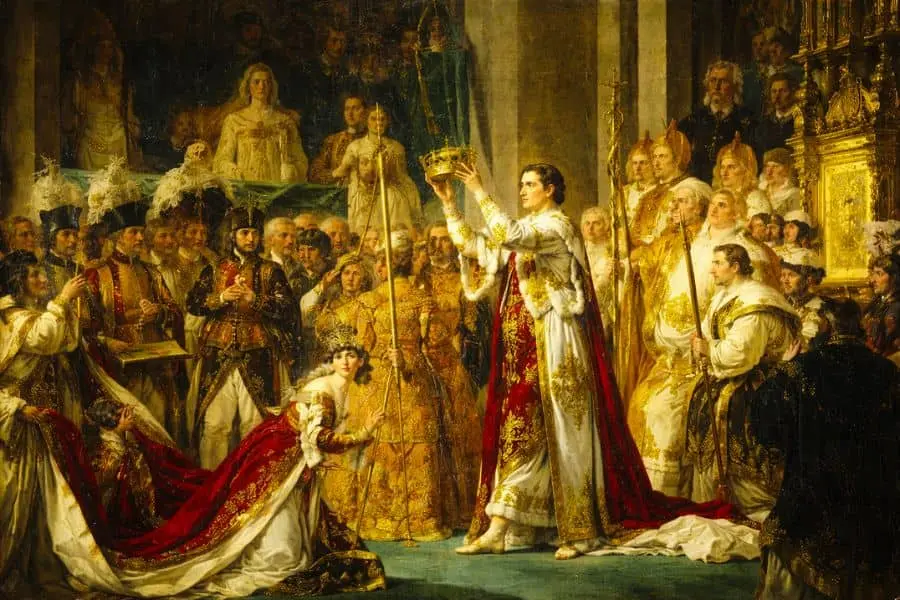
In 1804, Napoleon Bonaparte took a historic step that would change the political structure of France. After several years of consolidating power as First Consul, Napoleon declared himself Emperor of the French, establishing a new imperial government.
The coronation ceremony took place on December 2, 1804, at the famous Notre-Dame Cathedral. The event was attended by important political figures, members of the French government, and Pope Pius VII, who traveled from Rome to oversee the ceremony.
In a dramatic and symbolic moment, Napoleon took the crown from the pope and placed it on his own head. By crowning himself, he demonstrated that his authority came from his own achievements and the support of the French people rather than from the church or traditional monarchy.
This moment marked the official beginning of the First French Empire. Under Napoleon’s rule, France entered a period of major political, administrative, and military transformation.
Reforms and the Napoleonic Code
While Napoleon is widely known for his military campaigns, one of his most important and lasting contributions was the creation of the Napoleonic Code in 1804. This comprehensive legal system reorganized and standardized French laws, replacing the complex and inconsistent laws that had existed before the revolution.
The Napoleonic Code became one of the most influential legal reforms in modern history. It provided a clear set of laws that emphasized fairness, order, and equal treatment under the law. Over time, many countries in Europe and other parts of the world adopted legal systems inspired by this code.
Key reforms introduced under Napoleon included:
Legal Equality
The Napoleonic Code established the principle that all male citizens were equal before the law. It removed many privileges previously held by the nobility and strengthened the idea of a modern legal system based on fairness and justice.
Property Rights
The code strongly protected private property. This was especially important for many people who had gained land and assets during the French Revolution, ensuring their ownership would be legally secure.
Administrative Reforms
Napoleon also reorganized the government of France by creating a more efficient administrative system. Local governments were placed under stronger central authority, improving tax collection, infrastructure development, and national stability.
These reforms helped strengthen the French state and influenced legal systems in many parts of Europe, Latin America, and beyond. Even today, elements of the Napoleonic Code remain part of legal frameworks in several countries, making it one of Napoleon’s most lasting legacies.
Major Military Campaigns of Napoleon Bonaparte
The Battle of Austerlitz
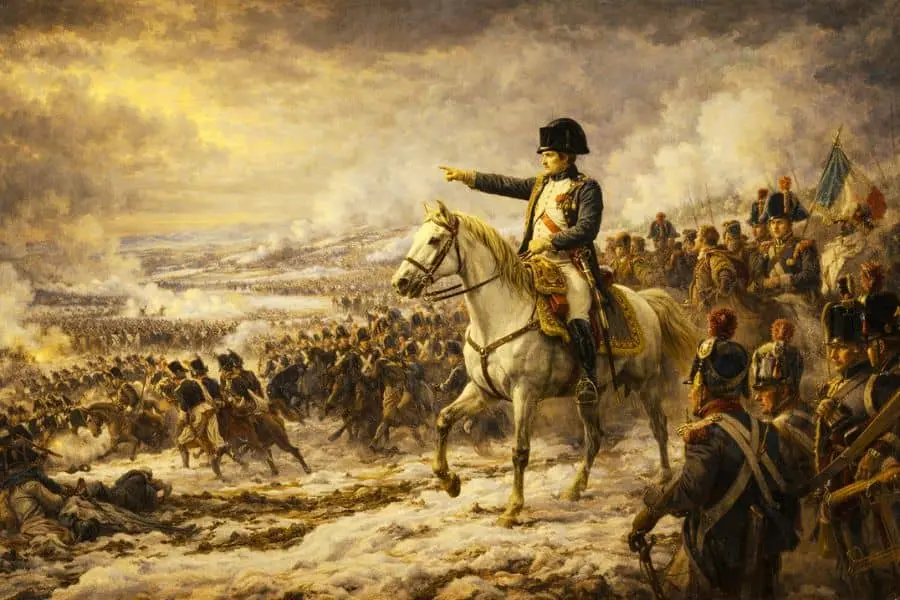
One of the most famous victories of Napoleon Bonaparte occurred during the Battle of Austerlitz on December 2, 1805. Often called the “Battle of the Three Emperors,” the conflict involved Napoleon’s French army against the combined forces of Russia and Austria.
Despite facing a larger enemy force, Napoleon used clever strategy and careful planning to secure a decisive victory. He deliberately weakened his right flank to lure the Allied armies into attacking what they believed was a vulnerable position. Once the enemy forces moved into the trap, Napoleon launched a powerful counterattack through the center of their lines.
The result was a crushing defeat for the opposing armies. The victory at Austerlitz forced Austria to sign the Treaty of Pressburg, strengthening French dominance in Central Europe. Historians often consider this battle to be Napoleon’s greatest military achievement and a perfect example of his tactical brilliance.
Expansion of the French Empire
Following victories like Austerlitz, Napoleon Bonaparte expanded French influence across much of the European continent during the Napoleonic Wars. Through both military conquest and political alliances, Napoleon gained control over large parts of Europe.
At the height of his power, the French Empire dominated territories including Italy, Spain, Germany, and parts of Poland. Many European states were reorganized under French influence, with Napoleon placing family members or trusted allies on several thrones.
To weaken his main rival, United Kingdom, Napoleon introduced the Continental System, an economic blockade designed to prevent European nations from trading with Britain. Although the system aimed to damage the British economy, it also created economic difficulties across Europe and increased resistance to French rule.
By the early 1810s, Napoleon had become the most powerful ruler in Europe, controlling a vast empire that stretched from Western Europe to the borders of Russia.
The Invasion of Russia
Napoleon’s dominance began to decline with the disastrous French invasion of Russia. The conflict started after tensions grew between France and Russia, particularly when Russia refused to fully follow the Continental System.
In June 1812, Napoleon led one of the largest armies in European history, known as the Grande Armée, into Russian territory. Initially, the campaign appeared promising, but Russian forces used a strategy of retreating and destroying supplies to weaken the advancing French army.
By the time Napoleon’s troops reached Moscow, the city had largely been abandoned and soon caught fire, leaving little food or shelter for the French soldiers. As winter approached, Napoleon was forced to retreat.
The retreat from Russia became a disaster. Harsh weather, starvation, and constant attacks from Russian forces destroyed much of the French army. Out of hundreds of thousands of soldiers who entered Russia, only a small fraction returned.
This catastrophic campaign severely weakened Napoleon’s military power and encouraged European nations to unite against him, marking the beginning of his eventual downfall.
The Fall of Napoleon Bonaparte
First Exile to Elba
After the disastrous French invasion of Russia, the power of Napoleon Bonaparte began to weaken rapidly. European nations that had long feared Napoleon’s dominance formed a powerful alliance against France. This coalition included countries such as Russia, Prussia, Austria, and the United Kingdom.
In 1814, these allied forces invaded France and captured Paris. Facing overwhelming pressure and political opposition, Napoleon was forced to abdicate the throne. The allies decided not to execute or imprison him permanently. Instead, he was exiled to the small Mediterranean island of Elba.
Although Elba was a tiny island, Napoleon was allowed to rule it as a small principality. However, he remained determined to regain his power in France.
The Hundred Days
In February 1815, Napoleon made a bold and unexpected escape from Elba and sailed back to France with a small group of loyal supporters. As he marched toward Paris, many soldiers sent to arrest him instead joined his cause.
This dramatic return marked the beginning of the Hundred Days, a short period when Napoleon regained control of the French government. The news of his return shocked European leaders, who quickly formed another military coalition to stop him.
Napoleon attempted to rebuild his army and prepare for a final campaign against the allied forces before they could fully organize their attack.
Defeat at the Battle of Waterloo
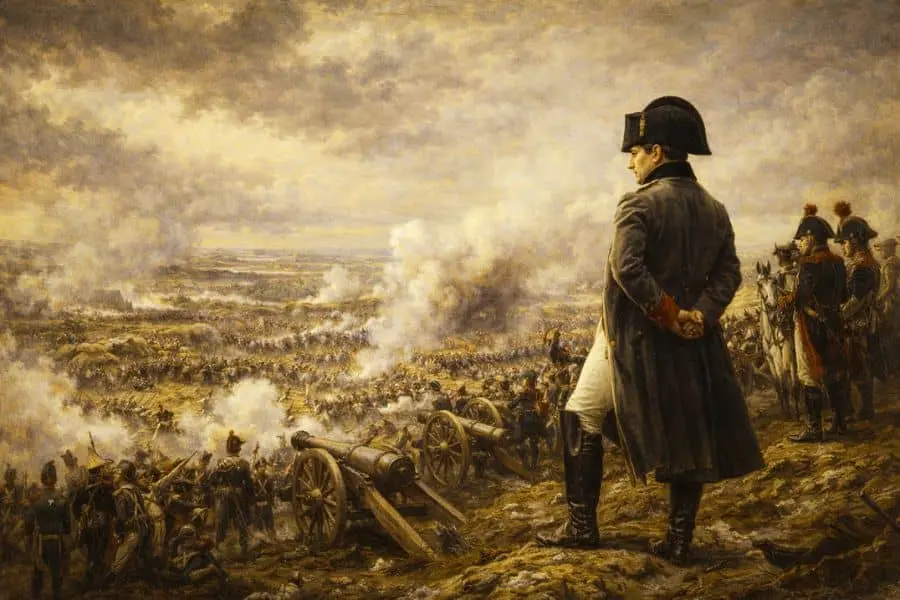
Napoleon’s final defeat came on June 18, 1815, at the Battle of Waterloo, in present-day Belgium. His army faced a coalition force led by Arthur Wellesley, 1st Duke of Wellington from the United Kingdom and supported by Prussian troops commanded by Gebhard Leberecht von Blücher.
The battle was intense and lasted for many hours. At first, Napoleon’s forces pushed back the allied lines, but the arrival of Prussian reinforcements turned the tide of the battle. Eventually, the French army was overwhelmed and forced to retreat.
After this decisive defeat, Napoleon was forced to abdicate the throne once again. This time, the allies sent him to a much more remote location to prevent another return to power.
The defeat at Waterloo ended Napoleon’s rule permanently and brought an end to more than a decade of conflict known as the Napoleonic Wars.
Napoleon Bonaparte’s Exile and Death
Life on Saint Helena
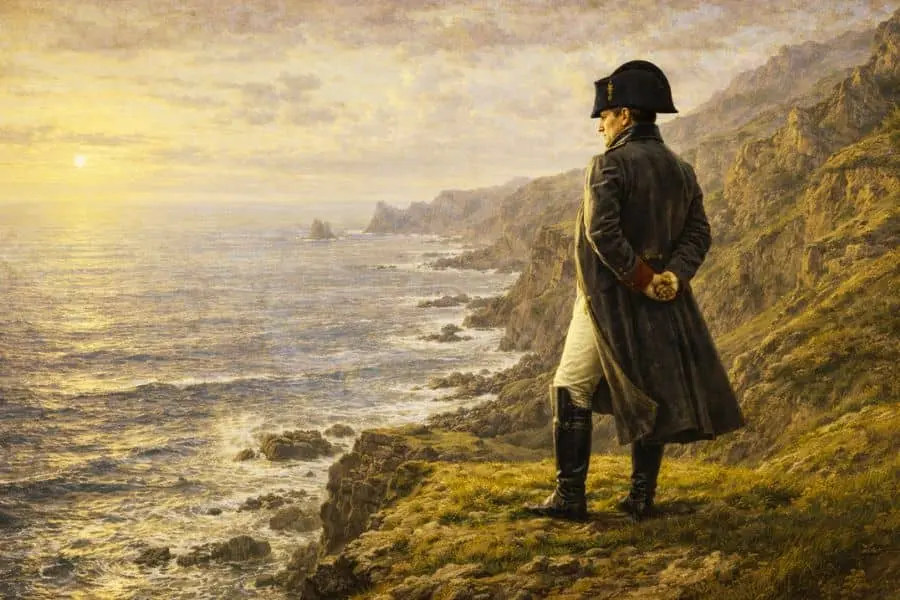
After his final defeat at the Battle of Waterloo in 1815, Napoleon Bonaparte was forced to abdicate the French throne once again. This time, the victorious European powers decided to send him far away to prevent any chance of another return to power.
Napoleon was exiled to Saint Helena, a small and isolated island in the South Atlantic Ocean controlled by the United Kingdom. Located thousands of miles from Europe, Saint Helena was chosen specifically because of its remote location, making escape nearly impossible.
During his years on the island, Napoleon lived under strict supervision by British authorities. Although he was no longer a ruler, he spent much of his time reading, writing, and reflecting on his life and achievements. He also dictated memoirs and discussed his campaigns with companions who had followed him into exile.
Despite the isolation and declining health, Napoleon remained a figure of great interest in Europe. His supporters continued to view him as a heroic leader, while his critics remembered the wars and conflicts that occurred during his rule.
Death and Historical Reflection
Napoleon Bonaparte died on May 5, 1821, at the age of 51 on the island of Saint Helena. Most historians believe that he died from stomach cancer, although the exact cause has been debated over the years.
Even after his death, Napoleon’s influence on world history remained significant. In 1840, his remains were returned to France and buried with great ceremony at Les Invalides in Paris.
Today, Napoleon is remembered as one of the most studied and debated figures in modern history. Scholars continue to analyze his leadership, military strategies, and political reforms to understand his lasting impact on Europe and the world.
The Legacy of Napoleon Bonaparte
Influence on Modern Law and Government
One of Napoleon’s most enduring achievements was the creation of the Napoleonic Code. Introduced in 1804, this legal system reorganized French law and established clear rules that emphasized fairness, order, and equal treatment before the law.
The Napoleonic Code removed many privileges previously held by the aristocracy and promoted legal equality for citizens. It also strengthened protections for private property and standardized laws across the country.
Over time, the code influenced legal systems in many parts of the world, including countries in Europe, Latin America, and beyond. Even today, elements of this legal framework continue to shape modern civil law systems.
Military Strategy and Leadership
Napoleon’s reputation as a military leader remains one of the most important aspects of his legacy. His innovative battlefield strategies, rapid troop movements, and effective use of artillery changed the way wars were fought in the early modern era.
Military academies around the world still study the campaigns of Napoleon Bonaparte, including famous battles such as the Battle of Austerlitz. His ability to analyze terrain, surprise opponents, and coordinate large armies is often cited as an example of exceptional strategic thinking.
For many historians and military experts, Napoleon remains one of the greatest commanders in military history.
Napoleon’s Place in World History
The legacy of Napoleon Bonaparte continues to inspire debate among historians and scholars. His life and actions can be viewed from several different perspectives.
Some see Napoleon as a military genius, whose leadership and strategic brilliance allowed him to build one of the most powerful empires in European history.
Others remember him as a dictator, arguing that his desire for power led to widespread wars and suffering across Europe during the Napoleonic Wars.
At the same time, many historians describe him as a reformer, highlighting his efforts to modernize government, reform laws, and strengthen national institutions in France.
Because of these complex and sometimes contradictory achievements, Napoleon remains one of the most fascinating and influential figures in world history. His life story continues to be studied, debated, and discussed by historians around the globe.
Conclusion
The life of Napoleon Bonaparte remains one of the most remarkable stories in world history. From his humble beginnings on the island of Corsica, Napoleon rose through the ranks of the French military during the French Revolution to become the powerful Emperor of France. His intelligence, ambition, and strategic brilliance allowed him to dominate European politics and warfare for more than a decade.
Throughout his career, Napoleon achieved extraordinary military victories and introduced important reforms, including the influential Napoleonic Code, which continues to shape legal systems in many parts of the world. However, his ambition also led to devastating conflicts across Europe, eventually resulting in his defeat at the Battle of Waterloo and exile to Saint Helena.
Despite his dramatic fall from power, Napoleon’s legacy continues to influence modern politics, military strategy, and legal systems. More than two centuries later, historians still study and debate his achievements, leadership style, and the lasting impact he had on European and global history.
FAQs
Why is Napoleon Bonaparte important in history?
Napoleon is important because he reshaped Europe through the Napoleonic Wars and introduced the Napoleonic Code, a legal system that influenced many modern laws around the world.
How did Napoleon Bonaparte lose power?
Napoleon lost power after his defeat at the Battle of Waterloo in 1815. After this final loss, he was exiled to the remote island of Saint Helena, where he spent the rest of his life.